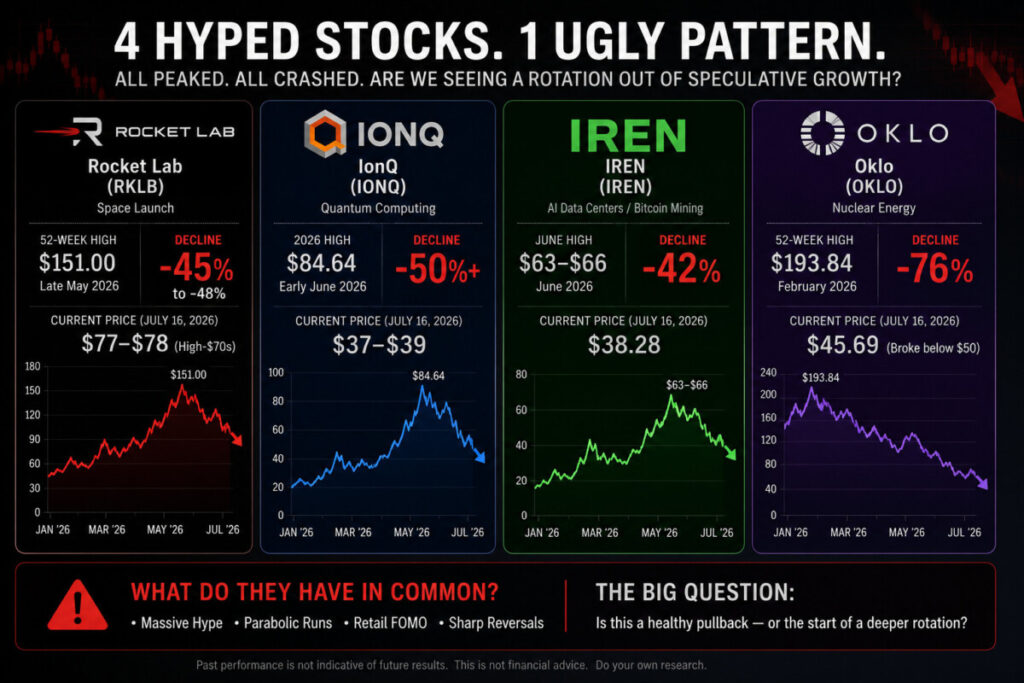
Something strange is happening across four completely unrelated industries. Rocket Lab (space), IonQ (quantum computing), IREN (AI data centers), and Oklo (nuclear energy) have almost nothing to do with each other on paper — yet their stock charts over the past six weeks look nearly identical: a sharp climb, a record high, and then a brutal, roughly 40-to-70% collapse. This isn’t a coincidence, and understanding the shared mechanism behind this speculative growth stock selloff tells you a lot about how this entire corner of the market actually works.
The Four Charts, Side by Side
Let’s look at the damage first, because the symmetry is the whole story.
Rocket Lab (RKLB) peaked near $151.00 in late May and has fallen 45–48% since, trading in the high-$70s by mid-July. IonQ (IONQ) set its 2026 high at $84.64 and is now down more than 50% from that peak, trading around $37–39. IREN, the AI data-center and Bitcoin-mining company, cratered roughly 42% from a June high near $63–66 down to about $38.28. Oklo, the nuclear-reactor startup, has fallen the hardest of all — down about 76% from its 52-week high of $193.84, now trading around $45.69, having broken below the psychologically important $50 level.
Four completely different sectors. Four remarkably similar-shaped charts.
The Common Thread: High-Beta “Story Stocks” With Thin Profits
Here’s the first thing all four share: none of them are mature, profitable businesses in the traditional sense. Rocket Lab still operates at a loss despite 63.5% revenue growth. IonQ posted a $271.5 million operating loss in Q1 2026 even as revenue jumped 755% year-over-year. IREN is still transitioning away from Bitcoin mining toward AI cloud computing, trading at a 97x P/E built on future promises. Oklo has no commercial revenue at all and won’t for years. Each of these stocks trades primarily on a story about the future — quantum computing, reusable rockets, AI infrastructure, next-generation nuclear — rather than on current earnings.
That distinction matters enormously in a risk-off environment. When investors get nervous, stocks priced on distant future potential get sold first and hardest, because there’s no earnings cushion to catch the fall. A company trading at 20 times this year’s profit has a floor. A company trading at 90 times next decade’s hoped-for revenue does not.
A quick fact-check worth noting on IonQ specifically: its Q1 2026 adjusted EBITDA loss was $96.8 million, and full-year guidance points to $310–330 million in adjusted EBITDA losses. Its GAAP operating loss for the quarter was larger, at $271.5 million — but GAAP net income actually came in positive, thanks to roughly $1.1 billion in non-cash warrant revaluation gains. That’s an important nuance: by every operating measure, IonQ is still burning significant cash, even though the accounting net-income line looked deceptively rosy.
The Second Thread: Fresh Dilution, Right When Sentiment Turned
Nearly every one of these four stocks has a dilution story attached to its drop, and the timing is not flattering. Rocket Lab’s ambitious $8 billion Iridium acquisition, announced in late June, raised concerns about financing and share dilution just as the stock was already correcting. IonQ continues to fund its widening losses (guided to $310–330 million in adjusted EBITDA losses for 2026) through ongoing share issuance and debt. IREN’s share count rose 38.5% year-over-year, and its co-CEOs recently received restricted stock awards worth roughly $700 million, equal to about 5% of shares outstanding. Oklo has been raising substantial capital through new stock offerings specifically because its elevated share price made doing so attractive — which is rational for the company, but it directly increases the share count investors are dividing the story by.
The Third Thread: New Competitors Pulling Capital Away
This is a subtler but real pattern: each stock faced a fresh competitor absorbing investor dollars at almost the same moment it began falling. IonQ’s decline coincided directly with European rival IQM Quantum Computers listing on the Nasdaq (ticker: IQMX) on July 2 — literally giving quantum-focused capital a brand-new place to go. Rocket Lab’s selloff has been explicitly linked to a “post-SpaceX IPO rotation out of space stocks”: SpaceX went public on June 12 at a valuation of roughly $1.77 trillion, and a company that size going public acts like a black hole, pulling investor attention and capital in the space sector toward itself. IREN, an AI-infrastructure story, was hit by news that Meta — backed by its roughly $50 billion Louisiana AI data-center investment — was standing up a new cloud division to resell its own excess AI computing capacity to outside companies, turning a would-be customer into a potential competitor almost overnight. In a sector with a fixed pool of speculative capital, a shiny new alternative can starve the incumbents of buying interest almost instantly.
The Fourth Thread: A Genuine Macro Risk-Off Trigger
Layered on top of all this company-specific noise was a real macro catalyst: rising geopolitical tension around the Strait of Hormuz and a sharp oil-price spike in early-to-mid July, which triggered broad risk-off selling specifically in high-beta, speculative names. IonQ’s beta of 3.23 meant it moved multiples of the broader market on the worst days. When the Nasdaq-100 fell just 1.48% on one representative session, pure-play quantum names still fell 6–9%, precisely because that’s what high-beta stocks do — they amplify whatever the market is feeling, in both directions.
What’s Genuinely Different: The Fundamentals Mostly Haven’t Broken
Here’s the part I find most important, and it cuts across all four names: in nearly every case, the actual underlying business hasn’t deteriorated — the multiple investors are willing to pay for it has. Rocket Lab’s revenue and backlog are both growing (backlog up 20% sequentially to $2.22 billion in Q1). IonQ just posted its “biggest quarter in company history” and raised full-year guidance, only to see the stock fall on the news anyway. IREN says all of its operational AI capacity remains fully contracted. Oklo continues clearing real regulatory milestones, including a DOE-approved safety analysis for its test reactor. Analysts across the board remain broadly bullish: 13 of 16 recent Rocket Lab ratings are Buys, and Wall Street’s average IREN target sits nearly 80% above its current price. This looks far more like a valuation reset after an unsustainable run than a verdict that any of these four businesses are actually failing.
The Lesson for Investors Holding These Kinds of Stocks
If you own any stock in this “story” category — pre-profit, high multiple, riding a megatrend narrative — this pattern is worth internalizing. These names will rise together on enthusiasm and fall together on fear, largely independent of their individual quarterly results. A drop like this isn’t necessarily a signal that the thesis is broken; it’s often simply what happens when a crowded, high-beta corner of the market gets repriced all at once. The flip side is equally true: the recovery, when sentiment turns, tends to be just as synchronized and just as fast. That combination — violent, correlated moves in both directions — is the defining feature of this entire category, and it’s exactly why sizing these positions modestly matters so much more than it does for a steady, earnings-backed blue chip.
https://www.tipranks.com/news/quantum-stocks-slide-why-ionq-rgti-and-qbts-fell-on-july-7
https://www.fool.com/investing/2026/07/11/why-oklo-stock-sank-27-in-the-first-half-of-2026
Final Thoughts
Rocket Lab, IonQ, IREN, and Oklo have almost nothing in common on a spreadsheet — except that they’re all speculative, pre-profit stories riding once-in-a-generation megatrends, and that made them all equally vulnerable to the same forces: thin earnings cushions, fresh dilution, competing capital raises stealing the spotlight, and a genuine macro risk-off shock. Their fundamentals, by and large, are still intact. Their valuations, for now, are the thing that got repriced.
Investment Disclaimer
This article reflects personal opinions and analysis based on publicly reported information. It is not financial, investment, tax, or legal advice, and I am not a licensed financial advisor. Pre-profit, high-multiple growth stocks carry substantial risk, including the potential loss of the entire investment, and past patterns of correlated selloffs and recoveries do not guarantee future behavior. Nothing here is a recommendation to buy or sell any security. Past performance does not guarantee future results, and all investing carries the risk of loss, including the loss of your entire principal. Please do your own research and consult a qualified, licensed professional before making any investment decision.