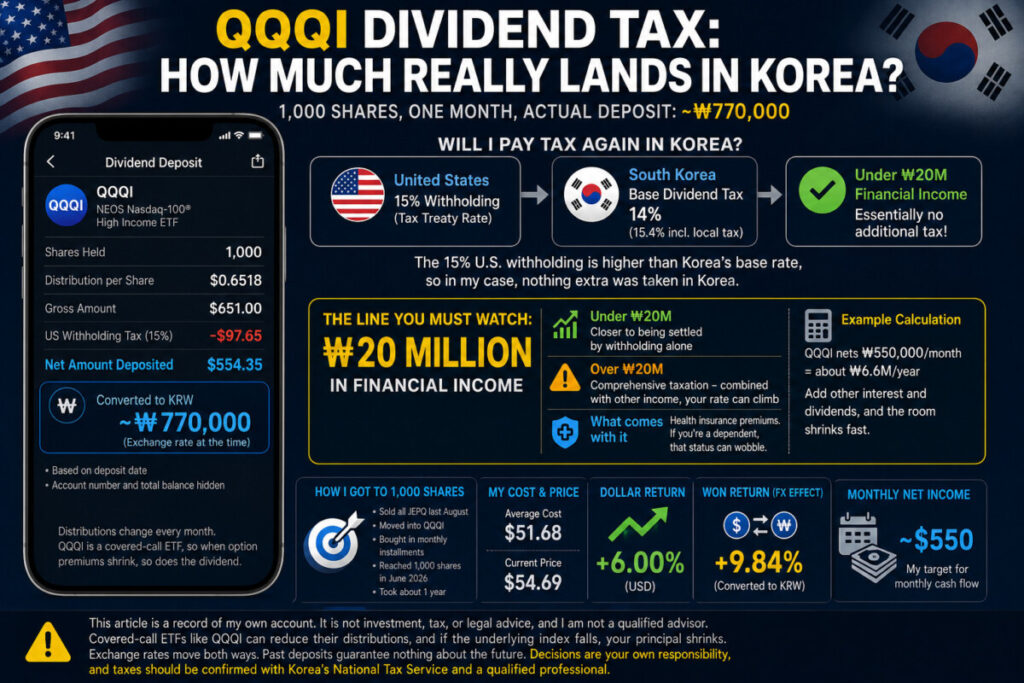
US dividends paid to Korean residents get 15% withheld in America before the money ever reaches your account. On my account, 1,000 shares of QQQI produced $651 before tax and $554 after — roughly ₩770,000 in one month.
This isn’t a stock recommendation. It’s the deposit record of one Seoul-based investor on parental leave, and a breakdown of how QQQI dividend tax actually works when you’re holding US assets from Korea.
What Actually Landed This Month
Here’s how a single month’s payment broke down.
| Item | Amount |
|---|---|
| Holding | QQQI, 1,000 shares |
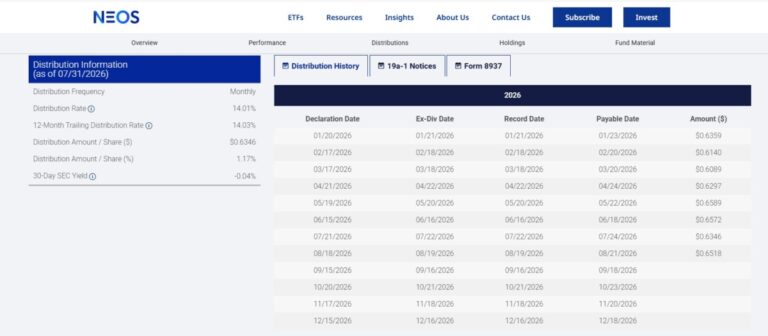
| Distribution per share | $0.6518 |
| Gross | $651 |
| US withholding (15%) | ~$97 |
| Net deposited | $554 |
| In won (rate at the time) | ~₩770,000 |
Distributions change every month. QQQI is a covered-call ETF, so when option premiums shrink, so does the deposit. The numbers above are my account that month, not a guaranteed monthly figure.
My average cost is $51.68 against a price of roughly $54.69 at the time. I plan around net monthly income of roughly $550.
Suggested image: brokerage app dividend deposit screen showing per-share amount, share count, and deposit total. Hide the account number and total balance. Alt text: QQQI dividend tax deposit screen showing gross and net
QQQI Dividend Tax: Does Korea Charge You Again?
The short answer, in my case, was no — and this surprises a lot of people.
Under the US-Korea tax treaty, the US withholds 15% on dividends. Without a treaty it would be 30%.
Korea’s base dividend income tax rate is 14% (structurally 15.4% including local tax). Because I already paid 15% in the US — higher than Korea’s base rate — when my financial income stayed below the threshold, essentially nothing additional came out for Korean dividend tax.
So the dollars showing in the app are close to the final, after-tax number. It isn’t “another 15% in Korea.”
That said, this reflects my account at that point in time. Brokerage withholding, comprehensive taxation, and health insurance premiums differ by person. Don’t use this as tax planning — verify with Korea’s National Tax Service and your brokerage.
The Line You Must Watch: ₩20 Million in Financial Income
The clean 15%-and-done story only holds while your annual financial income (interest plus dividends) stays under ₩20 million.
| Situation | How I understand it |
|---|---|
| Under ₩20M | Closer to being settled by withholding alone |
| Over ₩20M | Comprehensive taxation — combined with other income, your rate can climb |
| What comes with it | Health insurance premiums. If you’re a dependent, that status can wobble |
Health insurance isn’t a one-time payment — it recurs monthly. That’s why I watch the annual line as carefully as I watch growing the dividend itself.
And ₩20 million arrives faster than you’d think. If QQQI nets ₩550,000 a month, that’s about ₩6.6 million a year on its own. Add other interest and dividends and the room shrinks. This is part of my strategy, not a limit that fits everyone.
How I Got to 1,000 Shares
I worked as a project manager for 18 years. Instead of vague goals, I fix a number and break it into pieces.
So my milestone wasn’t “earn X amount.” It was 1,000 shares of QQQI.
Last August I sold all of my JEPQ and moved into QQQI, then bought in monthly installments. In June 2026, the app finally showed 1,000. That took roughly a year.
I’m on parental leave, so there’s no salary. The monthly dividend is one pillar of our living expenses, and being a dollar asset, it gives us breathing room when the won weakens. I think of it as a goose that lays golden eggs — I almost never run the math on selling. I only look at buying more when I can.
The honest caveat: covered-call ETFs cap your upside in rising markets, and if the index falls, your principal shrinks too. There’s no such thing as an investment that doesn’t fall. I hold this within that understanding, in a period of life where monthly cash matters more than maximum growth.
Suggested image: screen showing 1,000 shares held and the average cost. Alt text: QQQI dividend tax and 1,000-share average cost
Why 6% in Dollars Became 9.84% in Won
In pure dollar terms, my position is up about 6% — from $51.68 to roughly $54.69.
Over the same period, as the won weakened, my return converted to won came out around 9.84%.
If the exchange rate moves the other way, that bonus disappears. Currency is one of the main reasons Koreans hold US assets — and simultaneously the largest risk in doing so.
Frequently Asked Questions
Q. What percent is QQQI dividend tax in Korea?
My account received the money after 15% US withholding. Below ₩20 million in financial income, essentially nothing further came out for Korean dividend tax. Above that line, you need to look at comprehensive taxation and health insurance separately.
Q. Does 1,000 shares mean ₩770,000 every month?
No. That month the distribution was $0.6518 per share, netting $554, about ₩770,000. When distributions or exchange rates change, so does the deposit.
Q. Why QQQI instead of JEPQ?
At the time, the distribution rate fit my goal (monthly cash) better, so I switched. Both are Nasdaq-100 covered-call funds, and which is better right now depends on the person.
Q. Can I buy QQQI in an ISA account?
No. US-listed ETFs can’t be purchased in a Korean ISA. Domestically-listed monthly dividend ETFs use a different account type. The numbers in this article are from a foreign stock account.
Q. Do I need to file taxes separately?
It depends on the size of your financial income, whether you’re on workplace or regional health insurance, and your other interest and dividends. I’m not a tax accountant. Check the National Tax Service and your brokerage’s foreign stock tax guidance.
Final Thoughts
The reason QQQI dividend tax works out favorably for me isn’t clever planning — it’s just that the US treaty rate happens to exceed Korea’s base rate, and I keep my total financial income under the threshold that triggers everything else. Those two facts do most of the work.
What I control is the accumulation: one milestone, bought in pieces, over about a year. The tax structure is just what makes the arithmetic hold up.
Investment & Tax Disclaimer
This article is a record of my own account. It is not investment, tax, or legal advice, and I am not a qualified advisor. Covered-call ETFs like QQQI can reduce their distributions, and if the underlying index falls, your principal shrinks. Exchange rates move both ways. Past deposits guarantee nothing about the future. Decisions are your own responsibility, and taxes should be confirmed with Korea’s National Tax Service and a qualified professional.