Palantir just surged nearly 30% on what its CEO called an “otherworldly” quarter. As someone holding Micron and Korean memory exposure, my first thought wasn’t about Palantir at all — it was whether this is good news for hardware. The logic seemed obvious to me: if AI software is generating real, measurable revenue, then AI is actually being monetized, which means the demand for memory and compute isn’t a bubble. So I went digging into whether the Palantir earnings read-through to memory stocks actually holds up. The answer turned out to be more interesting than a simple yes.
What Palantir Reported
The numbers deserve their own paragraph because they’re genuinely remarkable.
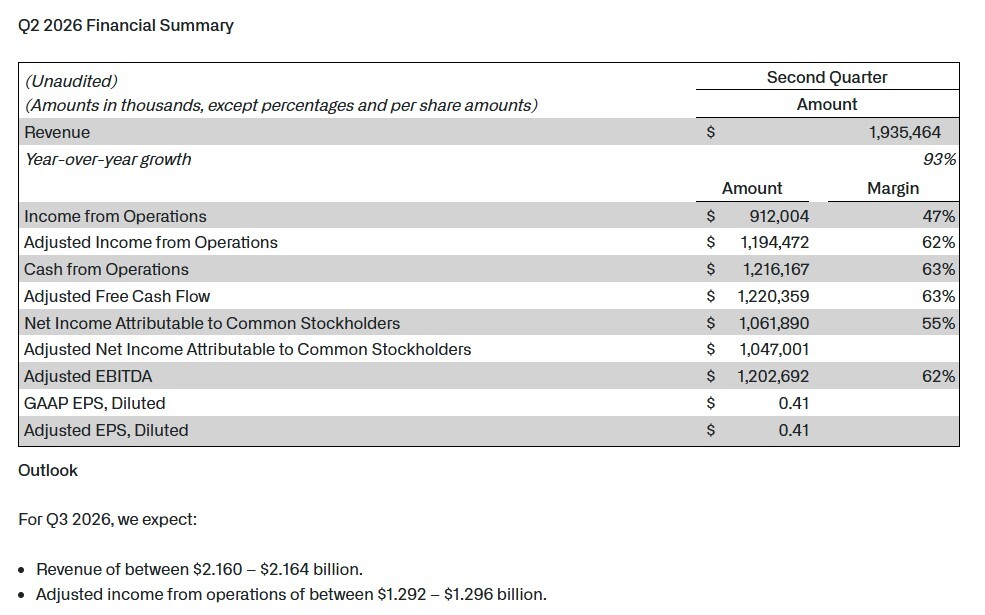
Revenue rose 93% year-over-year to $1.94 billion, beating the $1.8 billion consensus. Adjusted EPS came in at $0.41 against $0.35 expected. But the headline figure was US commercial revenue, which grew 149% year-over-year to $764 million — and by the company’s own math, has jumped 380% since 2024. US government revenue rose 90% to $809 million.
The contract data matters more to my question than the revenue line. Palantir closed 220 deals worth at least $1 million, including 73 deals of at least $10 million. Total contract value rose 49% to $3.37 billion, with US commercial TCV up 153% to $2.13 billion. Remaining US commercial deal value more than doubled to $6.24 billion.
And critically, this is profitable growth: GAAP operating income of $912 million (a 47% margin), adjusted operating income of $1.19 billion (62% margin), and $1.22 billion in adjusted free cash flow. Full-year revenue guidance was raised to roughly $8.16 billion.
CEO Alex Karp framed the quarter around “AI sovereignty” — enterprises wanting to keep data private rather than becoming, in his words, vassal states of the language labs.
https://www.cnbc.com/2026/08/04/palantir-2q-earnings-ai-sovereign-tools.html
The Bull Logic: Why This Should Help Hardware
Here’s the argument I started with, and I think it’s fundamentally sound.
The single biggest fear hanging over the entire AI trade — the one that has been crushing memory stocks all summer — is that hyperscalers are spending hundreds of billions on infrastructure without proof that AI generates real revenue. Alphabet’s free cash flow swung negative under the weight of its capex. Michael Burry shorted Micron. The bear case is simply: what if all this spending never gets paid back?
Palantir’s quarter is a direct counterargument. Wedbush’s Dan Ives called an earlier Palantir quarter proof that its AI platform “is monetizing AI,” describing the company as “one of the best barometers of AI demand globally.” This quarter’s version of that argument is stronger: 149% commercial growth, 62% adjusted operating margins, and $1.22 billion in free cash flow aren’t a promise of future monetization. They’re monetization happening now.
If enterprises are paying real money for AI outcomes and getting measurable value, they’ll keep deploying AI. Deploying AI requires compute. Compute requires memory. The chain runs: software proves ROI → enterprises expand AI deployment → hyperscalers keep spending → HBM and DRAM demand persists.
There’s a company-specific piece too. Palantir’s partnership with Dell — where Palantir’s software runs on Dell’s AI infrastructure — has been described as a visible channel through which software demand spills into hardware orders. That’s the read-through made literal.
The Complication: The Market Has Been Doing the Opposite
Here’s where my thesis met an uncomfortable fact, and I think it’s the most useful part of this whole exercise.
For much of this year, capital has been rotating out of AI software and into AI hardware, not the other way around. In late March, while Palantir and Oracle faced heavy selling, Micron was hitting all-time highs. One analysis described investors “aggressively rotating capital out of software-heavy ‘Stage 3’ AI firms and into the ‘Stage 2’ hardware and infrastructure backbone.”
The reasoning given was blunt: the demand story for AI chips is easier to see and measure. Every new AI data center needs processors and memory, and those orders are concrete. Software companies face a harder question — can they grow fast enough to justify their valuations? When investors get nervous, they favor the tangible demand story.
Palantir entered this earnings report down 29% year-to-date, precisely because of “broadening concerns that the AI software trade is running out of steam.”
So the relationship between these two groups hasn’t been the clean “software success lifts hardware” chain I imagined. At times they’ve traded as substitutes competing for the same pool of AI capital, not complements.
My Honest Conclusion
After working through both sides, here’s where I land — and I want to be clear this is opinion, not established fact.
The fundamental logic is right, but the timeframe matters enormously.
In the short run, a Palantir blowout can actually pull money away from memory stocks as capital rotates back toward software. Just weeks ago, on a day when semiconductors and memory sold off broadly, Palantir rose sharply on its own — the exact opposite of moving in sympathy.
In the medium to long run, though, I think the read-through is real and important. The bear case against memory has never been “nobody wants HBM.” It’s been “the customers buying HBM might stop, because their AI investments aren’t paying off.” Palantir just delivered hard evidence, on an income statement, that enterprise AI produces measurable economic value at scale. That doesn’t move memory stocks tomorrow. But it weakens the central argument for why the AI capex cycle would suddenly stop — and the capex cycle is the thing my memory positions actually depend on.
Put differently: Palantir’s earnings don’t tell you what Micron does this week. They tell you something about whether the demand underneath Micron is real. Those are different questions with different time horizons.
What I’m Actually Watching
This doesn’t change my monitoring checklist, but it does slightly strengthen my confidence in it. My exit rule for memory has always been hyperscaler capex — the day Microsoft, Google, Amazon, or Meta signals a pullback is the day the thesis breaks. Palantir’s quarter is indirect evidence that those hyperscalers’ customers are getting value, which makes an abrupt capex reversal somewhat less likely.
The honest caveat that keeps me grounded: Palantir now trades at more than 40 times expected 2026 revenue and around 93 times earnings. As one analysis put it, the quarter strengthened the business case far more than it resolved the valuation debate. Extraordinary execution and a sustainable stock price are separate questions — a lesson that applies just as much to the memory names I hold.
Final Thoughts
My instinct was that Palantir’s earnings should be good news for memory, and I still think that’s directionally right — just not in the way or on the timeline I first assumed. Software proving AI monetization doesn’t mechanically lift chip stocks the next day; sometimes it competes with them for capital. What it does is chip away at the single biggest fear underneath the entire hardware trade. For a long-term holder, that’s worth more than a one-day move.
Investment Disclaimer
This article reflects personal opinions and analysis of publicly reported information. It is not financial, investment, tax, or legal advice, and I am not a licensed financial advisor. Read-throughs between companies and sectors are speculative and frequently fail to materialize as expected. High-growth AI stocks carry substantial valuation risk, and memory chips remain a deeply cyclical sector. Nothing here is a recommendation to buy or sell any security. Past performance does not guarantee future results, and all investing carries the risk of loss, including the loss of your entire principal. Please do your own research and consult a qualified, licensed professional before making any investment decision.