Headlines have been flying around about a Micron buyback, and I want to clear something up first: Micron has not announced one. What actually happened is that UBS published a forecast suggesting Micron could repurchase more than 40% of its outstanding shares by 2028 — and the market ran with it. The distinction matters, but so does the underlying math, because if UBS is even half right, it’s one of the more remarkable capital-return stories in semiconductor history. Here’s what was really said, why buybacks move stock prices at all, and where I think the skepticism belongs.
What UBS Actually Said
Let’s be precise about the claim. UBS analyst Timothy Arcuri projects that Micron will generate more than $400 billion in free cash flow through calendar year 2028, driven by surging HBM and DRAM demand. At current prices, deploying that cash into repurchases could retire more than 40% of the company’s outstanding shares by the end of 2028.
There’s a critical timing detail, though. Micron is currently restricted from share repurchases through December 9, 2026 — a condition tied to its CHIPS Act funding. Until then, it can only do minor buybacks that offset employee stock-option dilution. UBS’s thesis is that once that restriction expires, Micron could channel essentially all of its free cash flow into buying back stock.
So this is a projection about what becomes possible after December 2026, not a corporate announcement. That said, the underlying cash generation isn’t fantasy: Micron generated $26.2 billion in levered free cash flow over the trailing twelve months, holds $26.02 billion in cash against just $6.38 billion in debt, and management itself expects free cash flow margins approaching 50–60% in coming years. The company has also locked in 16 strategic customer agreements with multiyear commitments that establish pricing floors and give revenue visibility through 2030.
The market reaction was immediate — Micron rose about 3.2% on the UBS note, then surged over 12% the following session after Bank of America added it to its “Best Investment Ideas” list with a $1,550 price target.
Why a Buyback Lifts a Stock: Four Mechanisms
For anyone wondering why a repurchase announcement is treated as such good news, it comes down to four things.
1. Earnings Per Share Goes Up (the decisive one)
The most important valuation metric here is EPS:
EPS = Net Income ÷ Shares Outstanding
When a company buys back stock and retires it, the denominator shrinks. Even if the company earns exactly the same profit, each remaining share is entitled to a bigger slice of it. Same pie, fewer pieces, thicker slices. Higher EPS on identical earnings mechanically supports a higher stock price.
This is why the 40% figure is so eye-catching. Retiring 40% of shares would, all else equal, boost EPS by roughly 67% — without the business earning a single extra dollar.
2. Supply and Demand Both Move in Your Favor
A buyback puts an enormous, price-insensitive buyer into the market: the company itself. Demand goes up. Meanwhile, retiring the purchased shares permanently shrinks the float. Supply goes down. Rising demand plus shrinking supply is textbook upward price pressure.
3. A Confidence Signal From Management
Executives and boards know more about their business than anyone. When they commit large sums to buying their own stock, they’re broadcasting two messages: we believe our shares are undervalued relative to what’s coming, and we’re confident enough in future cash flow to spend it this way. That signal alone often improves investor sentiment.
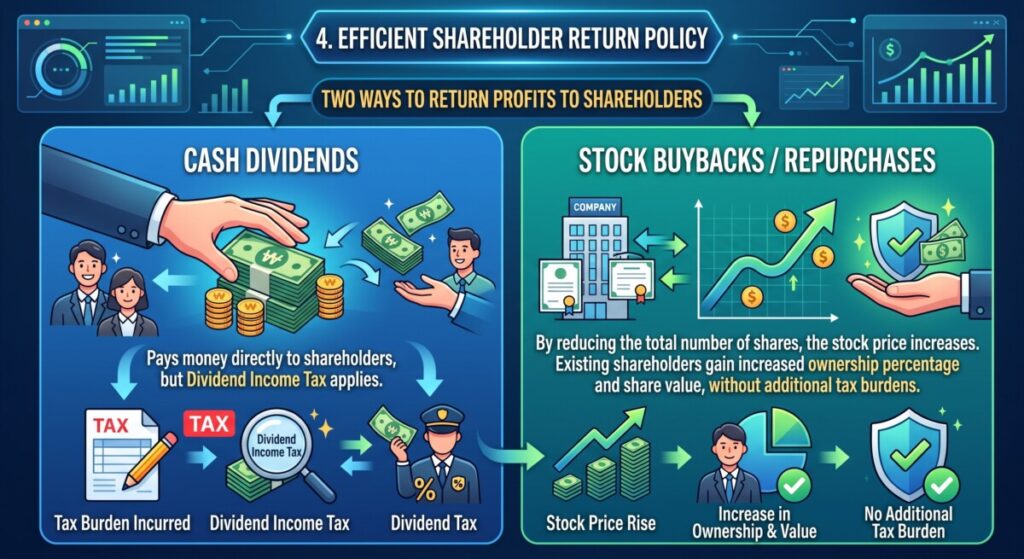
4. It’s Tax-Efficient Shareholder Return
Companies can return cash two ways. Dividends hand you money directly — but trigger dividend income tax immediately (for me as a Korean investor, that’s 15% withheld at source). Buybacks instead raise the value of the shares you already hold, so your ownership stake and per-share value grow without an immediate tax event. For long-term holders, that’s a meaningfully more efficient way to receive value.
Why the Stock Jumped on a Forecast
Put those mechanisms together and you understand the market’s reaction. Investors weren’t pricing in a buyback that happened — they were pricing in the prospect that Micron’s share count could shrink dramatically starting in 2027, making each remaining share far more valuable. Markets discount the future, and a credible path to retiring 40% of a company is a very large future to discount.
It also fits the broader memory narrative. UBS’s core thesis is a supply story: they believe HBM and DRAM shortages persist through 2028, keeping pricing elevated and margins fat, which is precisely what generates the $400 billion in the first place. The buyback case and the memory shortage case are the same case.
Where I’d Apply Some Skepticism
I don’t want to present only the bullish half, so here are the honest caveats.
It isn’t a plan — it’s a projection. Any actual repurchase would depend on cash flow materializing, market conditions, and board approval. None of that is committed today.
The cash flow forecast assumes the cycle holds. Memory is cyclical by nature. Consensus EPS growth for Micron looks explosive near-term — around 785% in 2026 and another 105% in 2027 — but is then expected to slow sharply to about 9% in 2028 and turn negative around 26% in 2029. If the cycle rolls over on that schedule, the back half of that $400 billion looks a lot shakier than the front half.
Companies often buy high. Buybacks tend to peak when cash is abundant, which is usually when the stock is expensive. Repurchasing 40% of a company near a cyclical peak destroys value rather than creating it.
Fourteen months is a long wait. The restriction doesn’t lift until December 9, 2026. A lot can change between now and then.
Final Thoughts
The Micron buyback story is a good lesson in reading headlines carefully. Nothing has been announced, and the eventual size depends on a cash flow forecast that assumes the memory shortage runs through 2028. But the mechanism the market is excited about is real: shrink the share count, and every remaining share commands a larger claim on the same profits. Whether Micron actually gets to deploy $400 billion that way is a question the memory cycle will answer, not an analyst note.
Investment Disclaimer
This article organizes publicly reported information and reflects personal opinion only. It is not financial, investment, tax, or legal advice, and I am not a licensed financial advisor. The buyback discussed here is an analyst projection, not a company commitment, and may never occur at the scale described. Analyst forecasts are frequently wrong, memory chips are a highly cyclical sector, and tax treatment of buybacks and dividends varies by individual circumstance and jurisdiction. Nothing here is a recommendation to buy or sell any security. Past performance does not guarantee future results, and all investing carries the risk of loss, including the loss of your entire principal. Please do your own research and consult a qualified, licensed professional before making any investment decision.