Everyone says “AI is causing a memory shortage.” But why, exactly? The AI memory shortage isn’t a vague supply-chain complaint — it comes down to arithmetic you can do on a napkin. Today I want to walk through three simple equations that explain the whole squeeze, then look at the two things that happened this week that made the story click for me: Google raising its capex guidance yet again, and Micron rising 3.2% on a day when war and $100 oil were dragging everything else down.
How AI Actually Uses Memory: GPUs Eat, Memory Delivers
Start with the basics. AI computation runs on GPUs, but a GPU alone can’t do anything — something has to keep feeding it data to calculate. That’s memory’s job.
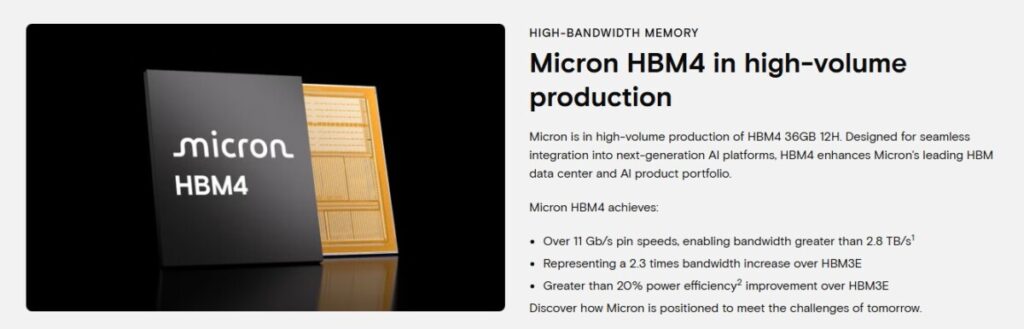
The analogy I use: the GPU is a mouth that eats incredibly fast, and memory is the conveyor belt bringing it food. No matter how fast the mouth chews, if the belt is slow, the GPU sits idle. That’s the “memory bottleneck,” and it’s why HBM (High Bandwidth Memory) exists.
Three things make HBM special. It’s stacked vertically — DRAM chips layered on top of each other to massively widen the data pathway. It’s placed right next to the GPU, cutting physical distance for ultra-fast transfer. And it’s effectively AI-specific, because large language models hold hundreds of billions of parameters in memory while computing, meaning bigger models need proportionally more of it.
In the AI era, memory isn’t storage. It’s the component that determines computational speed.
The Simple Math: Three Equations
Equation 1: HBM Is a Wafer-Eating Hippo
Producing 1GB of HBM consumes roughly 3× the wafer capacity of 1GB of regular DRAM
Because HBM requires stacking multiple layers plus precision bonding and packaging, the same storage capacity eats three times the silicon. Which means:
Make 1 million GB of HBM → lose the ability to make 3 million GB of regular DRAM
Every gigabyte of HBM produced evaporates conventional DRAM supply at triple speed.
Equation 2: The Great Capacity Migration
Now layer manufacturers’ choices on top. HBM carries far fatter margins, so:
Samsung, SK Hynix, and Micron have redirected roughly 93% of production toward HBM → HBM now consumes about 23% of all DRAM wafers (up from 19% in 2025) → Remaining conventional consumer and server DRAM supply = collapsing
Put simply:
Conventional DRAM supply = (total capacity) − (what HBM ate at 3× the rate)
The cake is the same size, but HBM is cutting itself a slice three times thicker than before. Everyone else fights over what’s left.
Equation 3: Price Is Just Supply and Demand
Price ∝ Demand ÷ Supply
Demand from AI data centers is exploding upward. Conventional DRAM supply is shrinking. The result is exactly what the math predicts: DRAM prices rose roughly 90% quarter-over-quarter in Q1 2026, Samsung lifted its 32GB DDR5 module price from $149 to $239 (a 60% jump), and DDR5 contract prices have more than doubled.
The one-line conclusion: AI’s HBM requires 3× the production capacity of regular DRAM, and manufacturers are pouring 93% of their capacity into it. Demand explodes, supply shrinks, chronic shortage and price spikes follow.
Why Can’t They Just Build More Fabs?
The obvious question. Two walls stand in the way.
Time. A semiconductor fab takes years to build. Starting construction today does nothing for today’s shortage.
Discipline. These three companies control over 90% of global DRAM. Having been badly burned by past oversupply cycles, they’re reluctant to expand recklessly and collapse their own pricing.
That’s why Samsung’s memory chief expects meaningful undersupply to persist through at least 2027, and why IDC has characterized this as a permanent reallocation of capacity toward AI rather than a temporary blip.
Is the Demand Real? Google Just Answered With $205 Billion
Here’s the question that decides everything: will AI demand actually last?
A powerful answer arrived yesterday. Alphabet raised its 2026 capex guidance again — from $180–190 billion to $195–205 billion, a midpoint around $200 billion (roughly ₩290 trillion). Nobody commits that kind of money without evidence. Google’s reasoning came in five parts.
Cloud revenue is exploding. Q2 Google Cloud revenue jumped 82% year-over-year to $24.8 billion, well past expectations — proof that companies really are spending on AI.
A $514 billion backlog. Google’s cloud backlog stands at $514 billion, meaning customers have already contractually committed to using the infrastructure being built now. This is the core justification for the spending.
They still can’t build fast enough. CFO Anat Ashkenazi stated plainly that Google remains “in a supply-constrained environment,” and that the guidance increase reflects accelerating capacity delivery to meet demand. They’re not short on customers — they’re short on capacity.
Usage metrics are surging. The Gemini app has 950 million active users, and API throughput hit 22 billion tokens per minute, up from 16 billion the prior quarter.
Vertical integration. With Gemini (models), TPUs (custom chips), Cloud, and advertising all under one roof, Google can recoup its investment across multiple businesses simultaneously rather than relying on cloud alone.
The CFO added that Google will keep investing “as long as returns look attractive,” and that 2027 capex will rise “significantly.” The funding was arranged in advance through roughly $84.8 billion raised in June.
But the market pushed back. Alphabet shares actually fell about 4% despite the strong results. The concern is timing of returns — Q2 free cash flow swung to negative $5.9 billion under the weight of that spending. This is precisely the bear argument that skeptics like Michael Burry have been making about the whole AI trade.
https://www.cnbc.com/2026/07/23/oil-prices-today-wti-brent-trump-iran-hormuz.html
The Tell: Micron Rose 3.2% While the World Burned
If you want a single piece of evidence that the memory shortage is being treated as structural rather than cyclical, look at yesterday’s tape.
It was an ugly day for risk assets. Brent crude surged more than 6% to close above $100 a barrel — a fifth straight session of gains and the highest since May — as the US-Iran war spread into the Red Sea. Trump warned of “major military punishment” against Iran and said he was considering a “massive attack,” after Houthi forces struck two Saudi oil tankers. Oil is now up more than 30% from pre-conflict levels this month, and Kazakhstan suspended crude exports through the Caspian Pipeline after drone attacks. RBC’s commodity strategist warned Brent could push past the 2022 high of $128 in an escalation.
That is a textbook risk-off environment. Markets were broadly weak. And Micron rose 3.2% anyway.
That divergence matters to me more than any single price move. When a stock climbs on a day when war and an energy shock are pushing everything else down, it’s a sign investors view its underlying driver as independent of the macro noise. The math above — 3× wafer consumption, 93% capacity migration, a shrinking supply of conventional DRAM — doesn’t care about the price of oil. Neither, apparently, does Micron’s bid.
Final Thoughts
The AI memory shortage isn’t mysterious once you see the arithmetic: HBM eats three times the capacity, manufacturers moved 93% of production into it, and the leftover supply for everything else collapsed. Google’s $205 billion capex commitment says the demand side isn’t slowing, and Micron’s green candle on a day of war and $100 oil suggests the market is starting to treat this as structural. The honest caveat is the same one Alphabet’s own stock reaction flagged: nobody knows exactly when all this capex gets paid back, and that question is the real risk hanging over the entire trade.
Investment Disclaimer
This article organizes publicly reported information for educational purposes and reflects personal opinion. It is not financial, investment, tax, or legal advice, and I am not a licensed financial advisor. Semiconductors and AI are extremely cyclical and volatile — a supply-shortage tailwind does not eliminate the risk of falling stock prices. Capex plans and demand forecasts can change at any time; verify figures against company filings and current sources. Past performance does not guarantee future results, and all investing carries the risk of loss, including the loss of your entire principal. Please do your own research and consult a qualified, licensed professional before making any investment decision.