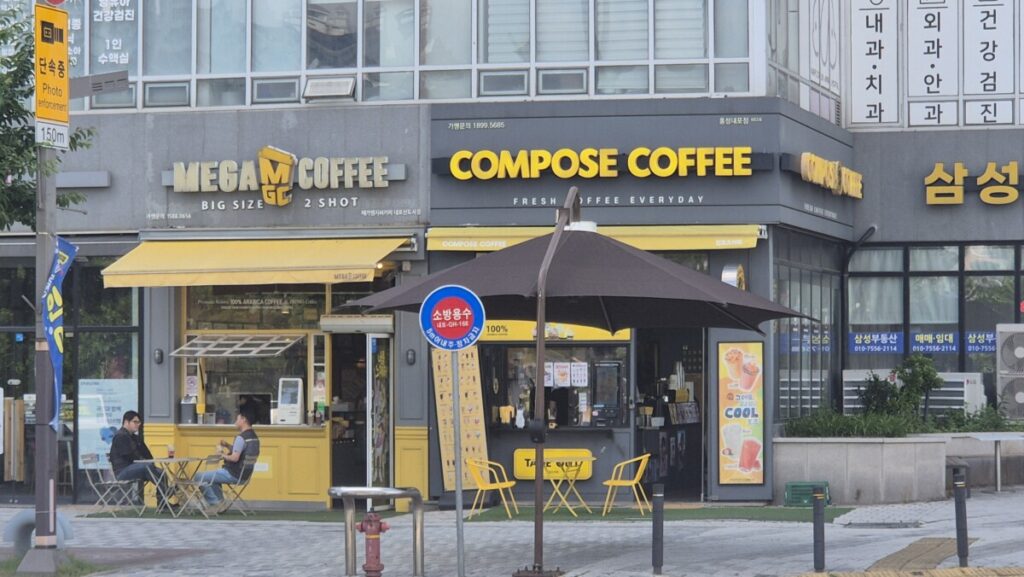
Walk down almost any street in Seoul and you’ll witness something genuinely surreal: three Starbucks visible at once, with a dozen other cafes squeezed between them. This isn’t an exaggeration — it’s daily life in what I like to call Korea’s Cafe Republic. South Korea has over 100,000 coffee shops, Seoul alone has more than 17,000, and the capital famously has more Starbucks outlets than any city on Earth, New York included. Koreans now drink around 405 cups of coffee per person every year — more than two and a half times the global average.
But here’s the thing: this dense forest of cafes isn’t just a quirky cultural fact. It’s a perfect, miniature window into the Korean economy — and once you understand why there are so many coffee shops, it hands you one of the most powerful investing lessons I know. Let me tell you the story.
Part 1: The Hidden Economics of Korea’s Cafe Republic
The number of cafes in Korea more than doubled between 2018 and 2022. People assume it’s pure demand — “Koreans just love coffee.” But the deeper truth is that Korea’s economic structure practically forces this supply into existence.
Early Retirement Meets Forced Self-Employment
Here’s a distinctly Korean pressure. Many Koreans are pushed out of their main career jobs surprisingly early — often in their late 40s to early 50s — long before they’ve saved enough to actually retire. They suddenly have a lump-sum severance, decades of life ahead, and no job. What’s the most intuitive thing to do with that capital and no specialized skills? Open a franchise cafe, where the head office hands you a manual and you just follow it. The low technical barrier to entry is exactly what makes it the default second act for a generation of involuntary entrepreneurs.
The Real-Estate Trap
Then there’s the property side. Whenever a new town or a big commercial building goes up in Korea, the first thing to fill the ground floor is — you guessed it — a cafe. Landlords desperate to avoid empty units and small-business owners hunting for a low-capital start meet in a perfect, self-reinforcing loop. The result is an endless wave of new cafe openings, whether or not the neighborhood actually needs another one.
A Red Ocean Where the Owner Barely Profits
The cruel punchline is what happens to the owner caught in this bloody competition. After paying rent, franchise royalties, labor costs, and payment-platform fees, there’s often very little left. The average franchised cafe in Korea brings in only around 158 million won a year in revenue — and most of that evaporates into costs. It’s a textbook red ocean: enormous activity, brutal competition, and razor-thin margins for the person actually pouring the coffee.
Part 2: The Investing Lesson — Don’t Fight at the Bloodiest Front Line
Look at this whole phenomenon through an investor’s eyes and one crisp principle emerges: never invest at the most competitive tail-end of consumption.
It’s tempting to think, “Coffee consumption keeps rising, so coffee franchise stocks must go up!” But that’s a trap. The barriers to entry are so low that a cheaper rival can appear overnight, and these businesses have weak pricing power — raise prices and customers simply walk to one of the hundred other cafes nearby. Rising coffee demand does not reliably translate into a rising stock price for the companies fighting over that demand. The front line is where margins go to die.
So the investor has to flip the entire perspective. Instead of spending 100–200 million won to open a physical cafe in that red ocean, what if you opened a virtual cafe in the stock market — one that delivers reliable cash into your account every single month?
Part 3: Open a “Virtual Cafe” of 1,000 Shares Instead
If the reality of self-employment is this harsh, the smarter path becomes obvious: build a cash-flow pipeline that needs no part-time staff to manage, no rent to pay, and no nervous turf war with the shop next door.
The QQQI 1,000-Share Project
This is exactly what I’ve done. Instead of a storefront, I built a position in QQQI — an ETF that captures the growth of America’s top Nasdaq tech companies while paying out high monthly distributions through a covered-call strategy. Put in just a fraction of what a physical cafe would cost, accumulate 1,000 shares, and every month a dollar dividend worth hundreds of cups of coffee lands in your account — without you ever brewing a single one. It’s a fully automated, unmanned revenue model. No 6 a.m. opening shift, no spilled milk, no franchise headquarters taking a cut.
Protect Your Profits With Tax-Smart Accounts
And just as a real cafe needs careful bookkeeping, a virtual cafe lives or dies by tax management. In Korea, the smart move is to shelter that dividend income inside tax-advantaged accounts — most notably the ISA (Individual Savings Account), which offers tax-free and separately-taxed benefits up to its limits, plus other tax-deferred wrappers for domestically-listed overseas ETFs. Every won you save from dividend tax is a won you can reinvest, building a compounding loop that a physical cafe owner, drowning in fixed costs, could only dream of.
The Final Insight
So here’s my challenge to you. The next time you walk past a beautiful new cafe in Korea and feel that flicker of “Maybe I should open a place like that,” try replacing the thought with this one: “I’ll buy a coffee at that cafe every day — paid for by the dividends from my account.”
That single mental flip is, I think, the most valuable survival strategy hidden inside Korea’s Cafe Republic. Instead of pouring your severance into a brutal red ocean, you own a slice of the world’s most innovative companies and let an unstoppable stream of dividends — sheltered by smart tax accounts — do the work for you.
Final Thoughts
Korea is a genuinely distinctive country, and its overflowing streets of cafes tell you more about its economy than any textbook could: early retirement, forced self-employment, a real-estate machine, and merciless competition all brewed into one cup. The investor’s job isn’t to join the crowd at the front line. It’s to step back, read the structure, and build something that pays you while everyone else is fighting over who pours the next latte.
Investment Disclaimer
This article reflects personal opinions and observations only. It is not financial, investment, or tax advice, and I am not a licensed financial advisor or tax professional. The ETF and account types mentioned describe a general approach, not recommendations, and tax rules and account benefits depend on your individual circumstances and can change — verify details with official sources and a qualified professional. Covered-call ETFs carry their own risks, including capped upside and potential erosion of principal. Past performance does not guarantee future results, and all investing carries the risk of loss, including the loss of your entire principal. Please do your own research before investing.