Today, two things happened at once. My memory shortage thesis got a real-world jolt of confirmation — Micron surged 12%, and this morning Samsung Electronics and SK Hynix are climbing right alongside it — and on the very same day, Micron’s quarterly dividend hit my account. A small deposit, but the timing felt symbolic. For weeks the memory sector has been a doom loop: US chips fall, Korean chips fall, and back again. Today, for the first time in a while, the air feels different. Here’s why I think this isn’t a coincidence, and why my little dividend and the whole cycle spring from the same root.
First, My Micron Dividend
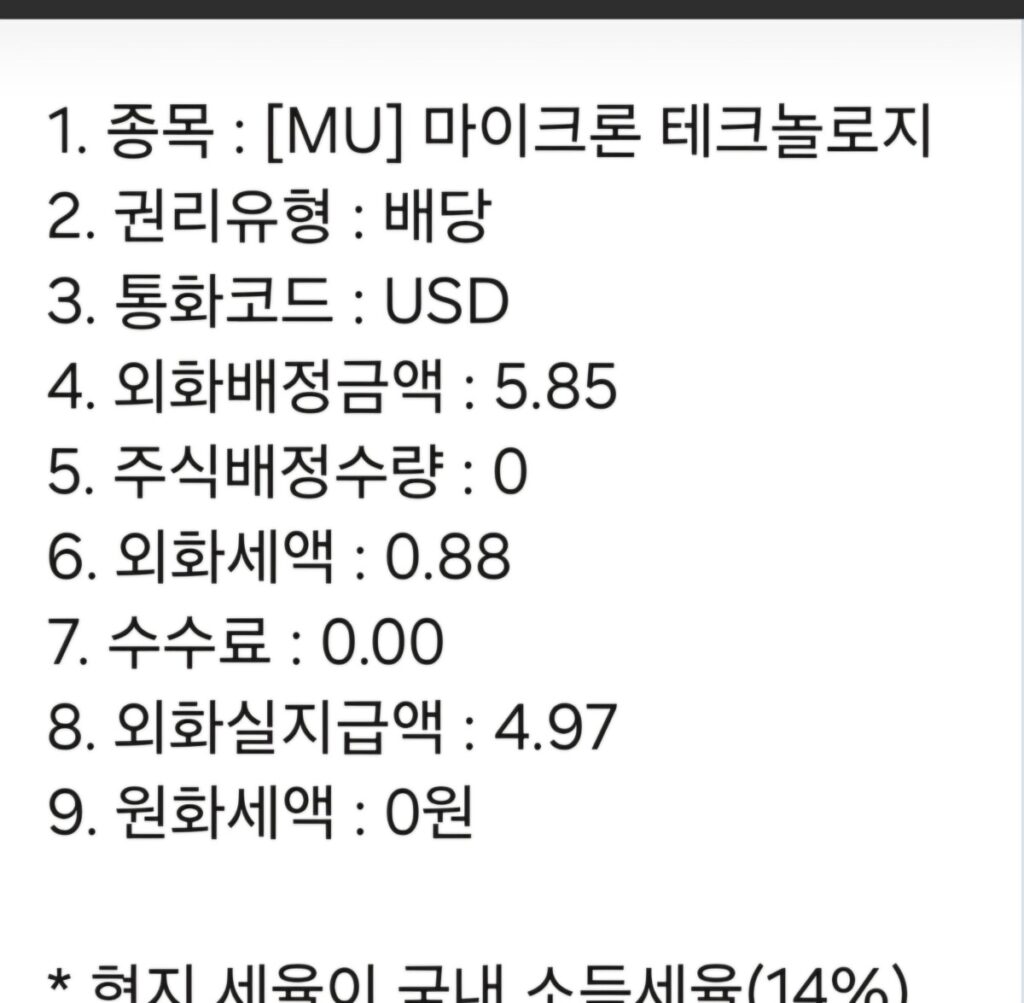
Let me start with the concrete thing sitting in my account. Micron paid its dividend today, and here’s exactly what it looked like for me:
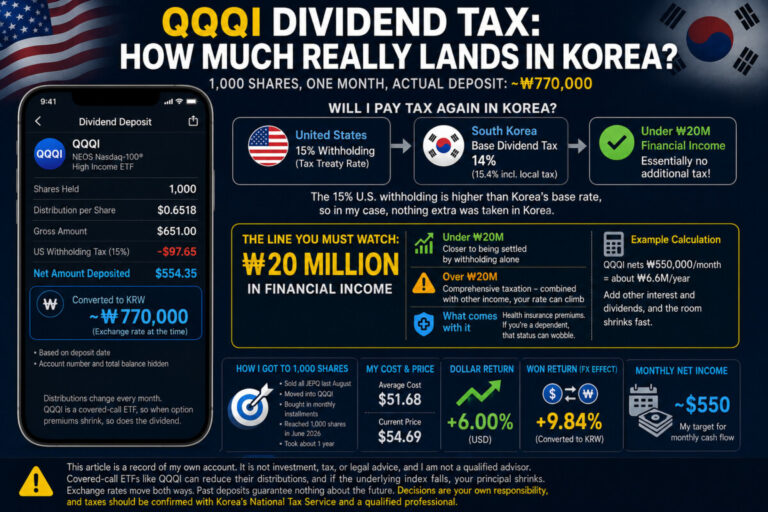
- Gross distribution: $5.85
- US withholding tax (15%): $0.88
- Net received: $4.97 (₩0 additional Korean tax)
That last line is the part I always find satisfying as a Korean investor. Because the US already withheld 15% — higher than Korea’s 14% base dividend rate — there’s no additional Korean tax to pay on this. The $4.97 is mine, clean. It’s a tiny amount, sure. But Micron’s dividend was never the reason I own it; it’s a small cash bonus on top of a position I hold for a much bigger thesis. And that thesis is exactly what lit up the tape today.
The Doom Loop, and the Day It Might Have Flipped
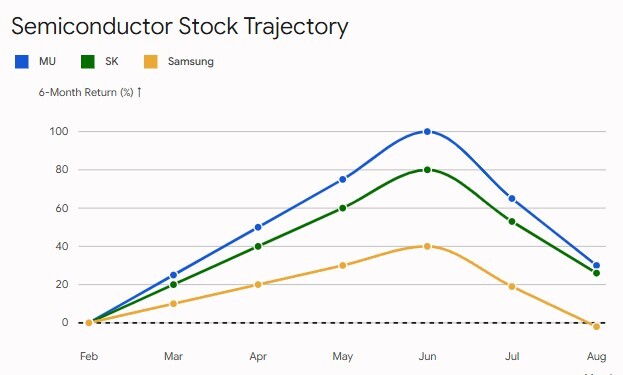
For the past few weeks, semiconductors have been the wire connecting Korea’s market and America’s market — and that wire was transmitting nothing but pain. Micron would drop overnight, so Samsung and SK Hynix would open lower in Seoul, and that Korean weakness would feed back into US sentiment. Down begets down.
Today looks like the mirror image. Micron jumped 12% on hardening conviction around the memory shortage, and Korean memory names are rising in sympathy. The question I want to answer honestly is whether this is a real regime change or just a good day. So I pulled the evidence together.
Why the Memory Shortage Story Is Real: Five Pillars
1. HBM Is Eating Regular DRAM Alive
Here’s the mechanism at the heart of everything. HBM — the high-bandwidth memory that feeds AI accelerators — needs roughly three times the wafer capacity to produce the same amount of storage as regular DRAM. As Samsung, SK Hynix, and Micron pour capacity into HBM, they’re starving the supply of conventional DRAM and NAND. Goldman Sachs projects a 4.9% DRAM undersupply in 2026 — the worst in more than 15 years. When the highest-value product cannibalizes the capacity for everything else, scarcity isn’t an accident; it’s built into the production math.
2. 2026 Is Essentially Sold Out
On its earnings call, SK Hynix said its HBM, DRAM, and NAND capacity is basically sold out for all of 2026, with hyperscalers pre-booking years of supply. Micron went so far as to exit the consumer memory market entirely to focus on enterprise and AI customers. You don’t walk away from a whole customer segment unless demand elsewhere is overwhelming.
3. Prices Are Exploding
This is where scarcity becomes profit. Global memory prices rose 80–90% quarter-over-quarter in Q1 2026, hitting record highs. Samsung lifted its 32GB DDR5 module price from $149 to $239 — a 60% jump — and DDR5 contract prices have more than doubled. Price spikes like these flow straight to the bottom line: Samsung’s operating profit rose 755% year-over-year, Micron’s net profit surged over 770%, and all three makers have crossed $1 trillion in market value. Rising prices mean exploding margins, exploding margins mean rising stocks.
4. Three Companies Control 90%+ of the Market
Samsung, SK Hynix, and Micron together control more than 90% of global DRAM. In an oligopoly this tight, the players don’t recklessly flood the market with new supply — they maintain “supply discipline,” which keeps prices firm for far longer than in a fragmented industry. (It’s worth noting this same dynamic has drawn a US price-fixing class-action lawsuit filed in June; the companies call it independent business judgment, not collusion. Either way, the pricing power is real.)
5. The Institutions Call It Structural, Not a Blip
This is the pillar that matters most for a long-term holder. Samsung’s memory chief has warned that meaningful undersupply will persist through at least 2027, and research firm IDC has framed the shift as a permanent reallocation of capacity toward AI. This isn’t being described as a one-quarter pop. It’s being described as a multi-year cycle.
Why This Makes a Virtuous Cycle Possible
Put those five pillars together and you understand why today’s move makes sense. Samsung, SK Hynix, and Micron all drink from the same well — the global memory market. A signal that memory demand and pricing are strengthening (Micron’s surge) is good news for all three, regardless of which country they’re listed in. So strength in one can now transmit to the others, exactly the way weakness did on the way down. The wire that spent weeks carrying declines can just as easily carry gains. That’s the virtuous cycle I’ve been hoping for: US up lifts Korea up, Korea up reinforces US up.
And my Micron dividend? It’s a tiny downstream drop from that same river. The company can pay me because the memory shortage is fattening its margins. The $4.97 and the 12% surge are the same story told at two different scales.
The Risks I Won’t Pretend Away
I’d be dishonest to end on pure optimism, so here’s the other side. Micron is up more than 200% year-to-date; a lot of good news is already priced in, and investor Michael Burry has publicly bet against it, calling the move a historic extreme. Memory is a cyclical industry by nature — today’s shortage becomes tomorrow’s glut if the three makers over-build to chase high prices. And the entire thesis rests on one assumption: that Big Tech keeps spending on AI data centers. The day the hyperscalers signal a capex pullback is the day this whole picture wobbles. A powerful tailwind is real, but it is not a guarantee of “up only.”
Final Thoughts
A $4.97 dividend won’t change my life. But watching it land on the exact day the memory shortage thesis flipped the sector from a doom loop toward a virtuous cycle was a neat reminder of why I hold what I hold. The dividend, the 12% surge, the Korean names rising in sympathy — all of it flows from the same source: AI is draining the world’s memory supply faster than three companies can refill it. I’ll keep collecting the small drops while watching the big river, with one eye always on the risks.