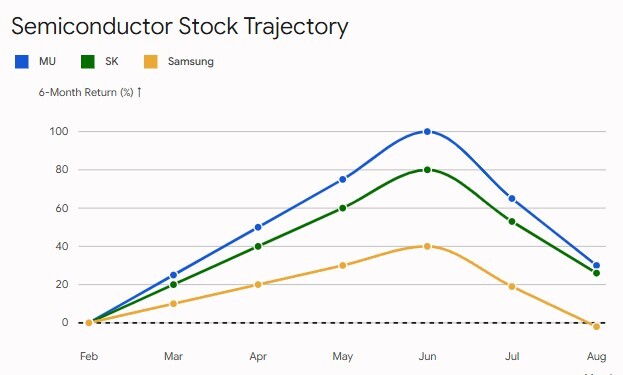
It is one of the most frustrating paradoxes in today’s stock market: AI hyperscaler spending is hitting record highs, High-Bandwidth Memory (HBM) is completely sold out through 2026 and 2027, and memory giants are posting record quarterly earnings—yet memory stocks are crashing.
If you hold Micron Technology (NASDAQ: MU), SK Hynix, Samsung Electronics, or semiconductor ETFs, you have likely felt the whip-saw volatility. Just as earnings reports blow past Wall Street estimates, a wave of aggressive selling knocks the stock price down by double digits.
As an investor currently holding 85 shares of Micron with a target to reach 100 shares, I refuse to trade on gut feelings or short-term panic. Instead, I evaluate memory stocks using a data-driven 10-point scoring framework grounded in fundamental unit economics.
In this article, I will unpack why Wall Street is pulling back on memory shares despite booming AI fundamentals, walk you through my 9/10 score for Micron, and explain the exact valuation math ($150 EPS × 10x P/E = $1,500 Target Price) that guides my dollar-cost averaging strategy.
Part 1: The Wall Street Disconnect — Why Are Memory Stocks Crashing?
To understand why memory stocks are pulling back during an unprecedented AI infrastructure wave, we must look at how institutional investors price cyclical industries. Market reports from sources like 24/7 Wall St. and market commentary from The Motley Fool highlight several structural forces driving the sell-off:
+-----------------------------------------------------------------------------------+
|                        THE MEMORY PARADOX: FUNDAMENTALS VS. PRICE                |
|                                                                                   |
|   Bullish Reality (Fundamentals)        vs.        Bearish Anxiety (Price Action) |
|   ------------------------------                   ------------------------------ |
|   • HBM Sold Out through 2027                       • "Cycle Peak" Fear            |
|   • Gross Margins Exceeding 80%                     • Hyperscaler CAPEX Rotation   |
|   • Multi-Billion Dollar EPS Beats                  • Institutional Profit-Taking  |
|   • Big Tech Spending Escalation                    • China CXMT Oversupply Fears  |
+-----------------------------------------------------------------------------------+
1. “Cycle Peak” Anxiety & Valuation Multiple Compression
Memory historically behaves as a commodity. When prices skyrocket and gross margins cross 80%, institutions begin fearing that the industry is at the peak of its cycle. As noted by financial strategists, Wall Street prices tomorrow’s potential supply glut rather than today’s record earnings. When investors fear that peak pricing power is near, earnings multiples compress rapidly.
2. Institutional Profit-Taking & Rebalancing
After massive multi-hundred percent rallies over the past year, hedge funds and institutional managers often lock in gains ahead of quarterly portfolio rebalancings. According to market coverage on Seeking Alpha and Fast Company, sharp dips in primary listed shares like SK Hynix and Samsung in Asia frequently trigger algorithmic sell stops across U.S. markets, magnifying short-term sell-offs.
3. Hyperscaler CAPEX Reallocation Concerns
While Big Tech (Microsoft, Meta, Amazon, Alphabet) continues to spend aggressively on AI, analysts observe that incremental capital is occasionally redirected toward power grid infrastructure, custom ASIC accelerators, and liquid cooling. This raises temporary concerns about memory’s relative share of future AI capex budgets.
4. Legacy DRAM vs. HBM Bifurcation
While HBM3E and next-generation HBM4 command premium pricing, lower-tier commodity memory (DDR4 and consumer PC/mobile DRAM) remains subject to capacity expansion risks from domestic Chinese fabricators like CXMT (ChangXin Memory Technologies).
Part 2: My 10-Point Investment Scoring Framework (Current Score: 9 / 10)
Without an objective framework, market noise will force you to buy at the top and panic-sell at the bottom. Short-term stock prices reflect market sentiment, but long-term share prices track corporate earnings.
Rather than checking stock charts daily, I track HBM demand visibility, DRAM pricing trends, hyperscaler AI CAPEX, and EPS revision trends. Here is my current breakdown for Micron:
+---------------------------------------------------------------------------+
|                      MICRON WEEKLY INVESTMENT SCORE                       |
+------------------------------------+---------------------+----------------+
| Metric Category                    | Score Contribution  | Status         |
+------------------------------------+---------------------+----------------+
| 1. HBM Demand & Capacity Visibility| +2 Points           | Maximum Bull   |
| 2. DRAM Average Selling Price (ASP)| +2 Points           | Upward Trend   |
| 3. EPS Guidance & Beats            | +2 Points           | Outperforming  |
| 4. Hyperscaler AI CAPEX Expansion  | +2 Points           | Accelerating   |
| 5. Gross Profit Margin Trajectory  | +1 Point            | High (>80%)    |
| 6. Market Addressable Expansion    | +1 Point            | Broadening     |
| 7. Chinese Supply Expansion Risk   | -1 Point            | Risk Deduction |
+------------------------------------+---------------------+----------------+
| FINAL SCORE                        | 9 / 10              | STRONG BUY/DCA |
+------------------------------------+---------------------+----------------+
Breakdown of the 9-Point Rating:
- HBM Demand Expansion (+2 Points):Demand for High-Bandwidth Memory used in server GPUs continues to outstrip supply. Micron’s management has explicitly confirmed that its HBM production capacity is completely sold out through 2026, with clear revenue visibility extending into 2027. There is currently no line-of-sight to supply catching up with customer demand.
- DRAM Pricing Power (+2 Points):Clean DRAM pricing trends remain in a firm upward trajectory. Because wafer allocation is being prioritized for complex HBM stacks, conventional server DRAM and DDR5 face structural supply constraints, preserving Micron’s pricing power.
- EPS Guidance Revisions (+2 Points):Earnings per share (EPS) revisions remain the single most reliable predictor of stock performance. Micron crushed Wall Street expectations by posting quarterly EPS over $25 (against consensus estimates of $20) and guiding upcoming revenues near $50 Billion—substantially ahead of analyst models.
- Hyperscaler AI Investment (+2 Points):Big Tech capex commitments remain relentless. Microsoft, Meta, Amazon, and Alphabet are expanding their custom data center builds. Every accelerated computing cluster requires vast pools of high-speed memory.
- Gross Margin Expansion (+1 Point):Micron is projecting fiscal fourth-quarter gross margins above 80%. Achieving margins of this scale in a hardware manufacturing business illustrates incredible operational leverage.
- Customer & Application Expansion (+1 Point):AI memory is expanding beyond centralized cloud data centers into automotive AI, humanoid robotics, edge computing devices, and enterprise AI workstations.
- Deduction: Chinese Capacity Expansion (-1 Point):China’s CXMT is aggressively expanding capacity in standard DDR4 and low-power DRAM. While CXMT cannot currently manufacture high-yield HBM3E or advanced DDR5, its volume expansion introduces potential long-term oversupply risk in legacy memory tiers.
Investment Rule Execution
My rule is straightforward: Any score of 7 points or higher signals a green light for disciplined accumulation. Because the current score stands at 9 / 10, my thesis remains intact. I hold 85 shares and plan to dollar-cost average into my 100-share milestone during market pullbacks.
Part 3: The Math Behind My $1,500 Long-Term Target Price
Is a $1,500 price target on Micron realistic, or is it pure speculation? It comes down to a simple, fundamental equity formula:
$$\text{Stock Price} = \text{Earnings Per Share (EPS)} \times \text{Price-to-Earnings Ratio (P/E)}$$
+---------------------------------------------------------------------------+
|                  MICRON LONG-TERM VALUATION MODEL ($1,500)                |
|                                                                           |
|    Projected Annualized EPS ($150)  ×  Target P/E Multiple (10x)          |
|    --------------------------------------------------------------         |
|    = Target Share Price: $1,500                                           |
+---------------------------------------------------------------------------+
Modeling the Inputs:
- Projected EPS ($150): As memory shifts from a commodity model to a long-term contracted utility model for AI infrastructure, annual EPS capacity expands dramatically. Industry analysis covered by TradingKey notes that several Wall Street firms—including Susquehanna (target $1,750) and Needham (target $1,550)—model FY2027 EPS reaching $160.
- Target P/E Multiple (10x): Historically, cyclical memory stocks trade at conservative mid-cycle multiples between 8x and 12x. Applying a modest 10x multiple to a $150 EPS yields:
$$\$150 \times 10 = \$1,500$$
Major Wall Street institutions, including Bank of America, Deutsche Bank, TD Cowen, and Cantor Fitzgerald, have raised their long-term target prices toward $1,500 as memory values are re-rated in the AI era.
Risk Sensitivity & Scenario Analysis:
A price target is a dynamic model based on assumptions, not a guarantee.
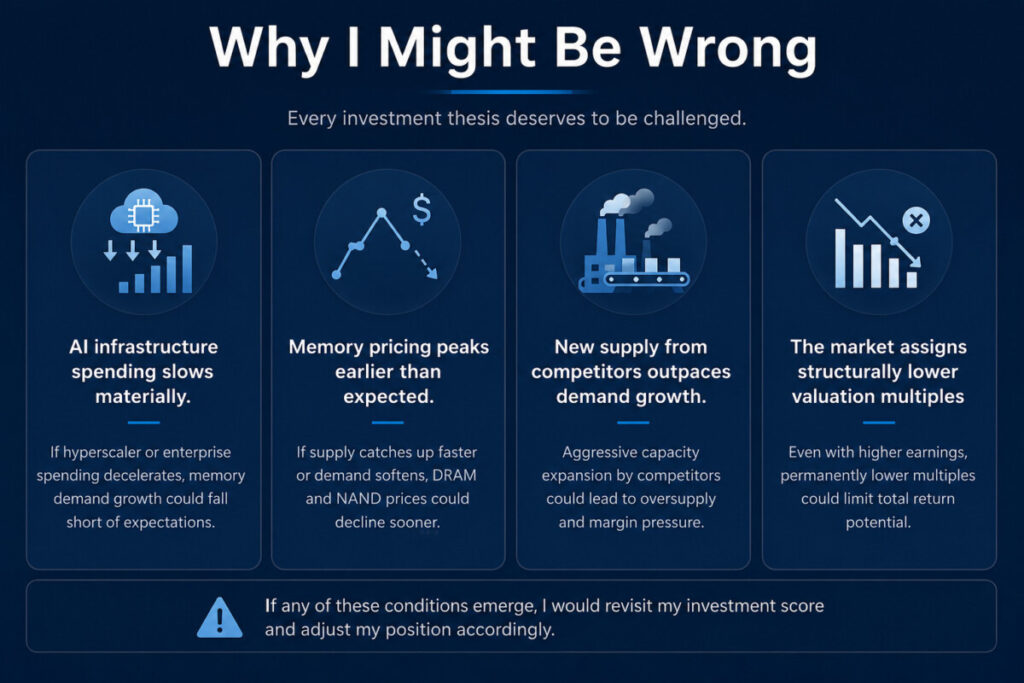
- If memory pricing declines earlier than anticipated, EPS could settle lower (e.g., $80 to $100).
- If market sentiment compresses the P/E multiple to 5x or 6x during a broader macroeconomic downturn, the target price would adjust downward accordingly.
By regularly updating EPS consensus data and P/E multiples, investors can maintain emotional control even when headline prices swing violently.
Part 4: Investor Takeaway & Execution Strategy
When memory stocks are crashing despite strong fundamental tailwinds, market volatility usually reflects sentiment shifts, profit-taking, and cycle-timing anxiety—not a collapse in underlying chip orders.
+---------------------------------------------------------------------------+
|                          INVESTOR ACTION PLAN                             |
+---------------------------------------------------------------------------+
| 1. Separate Short-Term Sentiment from Multi-Year Earnings Fundamentals.   |
| 2. Rely on a Scoring System Rather Than Daily Price Charts.               |
| 3. Accumulate Step-by-Step During Sector-Wide Pullbacks (Score >= 7).     |
| 4. Re-evaluate Positions Immediately If Core Metrics (HBM/EPS) Deteriorate.|
+---------------------------------------------------------------------------+
My Strategy Moving Forward:
- Hold My 85 Shares: I am not selling into emotional panics or institutional profit-taking.
- Phase Purchases to Reach 100 Shares: I will use ongoing market dips to buy the remaining 15 shares in structured, dollar-cost-averaged tranches.
- Continuously Audit the Score: If Big Tech capex cuts occur or HBM cancellation reports surface, the investment score will drop below 7, triggering a position review. Until then, the thesis remains solid.
What Is Your Investment Framework?
Are you holding through this memory stock pullback, or are you waiting on the sidelines for prices to settle? What metrics do you track before adding to your portfolio? Share your thoughts in the comments below!
Disclaimer: This article expresses personal investment strategies and quantitative scoring methodologies for educational purposes only. It does not constitute financial advice or a recommendation to buy or sell any security. Semiconductor investments carry cyclical and market risks. Always perform your own due diligence.