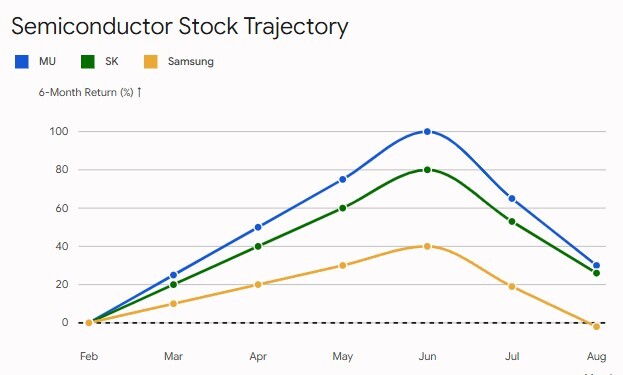
For years, the relationship only ran one way: Wall Street sneezed, and Seoul caught a cold. Now something genuinely new is happening, and as someone investing from inside Korea, I find it fascinating. Korean memory stocks — specifically Samsung Electronics and SK Hynix — are starting to influence US memory stocks like Micron, not just the other way around. The old rule used to be “check the US market overnight to know how the Korean market will open.” That rule is quietly bending.
The Old Direction: Wall Street Leads, Korea Follows
Let’s be honest about the baseline, because it’s still the dominant pattern. On July 2, 2026, US chip stocks slumped overnight, and the very next morning, Samsung Electronics fell over 7% and SK Hynix sank more than 9% at the open — so violently that it triggered an emergency trading halt on the KOSPI. Nasdaq weakness spilling into Asia the next trading session has been the textbook pattern for decades, and it’s still very real. If you traded Korean stocks a decade ago, you already know this instinct: watch the US close, then guess how Korea opens.
The New Twist: Why Korean Memory Stocks Are Starting to Lead
But here’s what’s changing, and it’s the part I think foreign readers will find genuinely interesting.
HBM Supply Signals Now Flow From Korea to the US
Samsung and SK Hynix are, by revenue share, the two largest producers of HBM (high-bandwidth memory) in the world — SK Hynix alone commands roughly 58% of the global HBM market, with Samsung and Micron essentially tied for second at around 21% each. Because of that dominance, comments and data coming out of Korea now shape global sentiment about memory supply tightness. When SK Hynix’s CEO says supply shortages will only get worse, or when Samsung announces it has caught up in mass-producing HBM4, those statements move the entire memory trade — including Micron — because the market treats Korea’s two giants as the bellwether for the whole industry’s supply-demand balance.
The Structural Reason: SK Hynix Is Coming to the Nasdaq
Here’s the development that could make this “tail wagging the dog” dynamic literal and permanent. SK Hynix is listing American Depositary Receipts (ADRs) directly on the Nasdaq under the ticker “SKHY,” with trading set to begin July 10, 2026 — one of the largest US listings by a foreign company in recent memory, raising up to roughly $29.4 billion. Once that happens, SK Hynix will no longer be some distant Korean stock that Western investors read about secondhand. It will trade directly alongside Micron, in the same market, during the same hours, priced by the same global investors. When two of the three companies making the world’s AI memory chips both trade on Wall Street, Korea’s earnings and outlook stop being background noise for the US market — they become part of the same trading session.
Why Valuation Gaps Are Forcing US Investors to Pay Attention
Analysts have also pointed out that SK Hynix trades at a striking discount to Micron despite arguably having the stronger position in HBM — a forward P/E of roughly 8x versus a US semiconductor peer group priced far richer. As SK Hynix’s Nasdaq listing forces a direct valuation comparison, that gap is expected to narrow, which means US capital may increasingly flow based on how Korea’s memory giants are performing, not the reverse.
Was I Seeing This Correctly Today?
To answer the question that started this whole post: yes, the instinct is real, but it’s not yet the dominant force — it’s an emerging one layered on top of the older pattern. Korean memory stocks and US memory stocks are becoming, in the words of one market analyst, “a single, connected trade.” A rally driven by Korean investment announcements can lift US premarket sentiment on the same day, just as a Wall Street selloff can still hammer the KOSPI the next morning. Both directions coexist right now — but the Korea-to-US channel, which barely existed a few years ago, is the genuinely new and growing part of the story.
Why This Feels Like Poetic Justice to a Korean Investor
I have to admit, there’s something almost funny about this to those of us who’ve invested in Korea for years. It used to be that Korean retail investors (“개미,” or “ants,” as we call ourselves) would check the US market close every single morning before deciding whether to buy or sell Korean stocks — the US was the fortune-teller, and Korea was just along for the ride. Watching Samsung and SK Hynix start to influence Micron, even partially, feels like a small but real reversal of that old hierarchy. Korea spent decades reacting to America’s memory cycle. Now, for the first time, America is starting to react to Korea’s.
What This Means for Investors Like Me
For anyone holding memory exposure on either side of the Pacific — whether that’s Micron directly, or a Korean index fund like the KOSPI 200 covered-call ETFs I hold — this growing two-way link means the whole memory trade increasingly moves as one unit. A hot HBM comment out of Icheon can now ripple into Micron’s premarket trading, and a US tech selloff can still slam the KOSPI by breakfast in Seoul. Watching both sides has become less optional and more necessary than ever.
Final Thoughts
The old rule — “watch Wall Street to predict Korea” — hasn’t disappeared, but it’s no longer the whole story. With SK Hynix about to trade directly on the Nasdaq and Korea’s two memory giants controlling the global HBM supply narrative, Korean memory stocks are increasingly capable of moving the very US market that used to move them. As a Korean investor watching this unfold in real time, I think it’s one of the more quietly historic shifts in global markets right now.
Investment Disclaimer
This article reflects personal opinions and observations only. It is not financial, investment, tax, or legal advice, and I am not a licensed financial advisor. Cross-market correlations can weaken, strengthen, or reverse without warning, and past patterns of influence between markets do not guarantee future behavior. Nothing here is a recommendation to buy or sell any security. Past performance does not guarantee future results, and all investing carries the risk of loss, including the loss of your entire principal. Please do your own research and consult a qualified, licensed professional before making any investment decision.