Today I watched Korea’s stock market fall almost 10% in a single day. The KOSPI crash on June 23, 2026 was historic — circuit breakers, sell sidecars, a sea of red on every screen. And as painful as it was to witness, it quietly confirmed the single most important decision in my entire investing strategy: keeping the overwhelming majority of my money in US stocks and only a small, carefully managed slice in Korea. Let me show you exactly why a day like this proves the point.
What Happened Today: Korea’s “Black Tuesday”
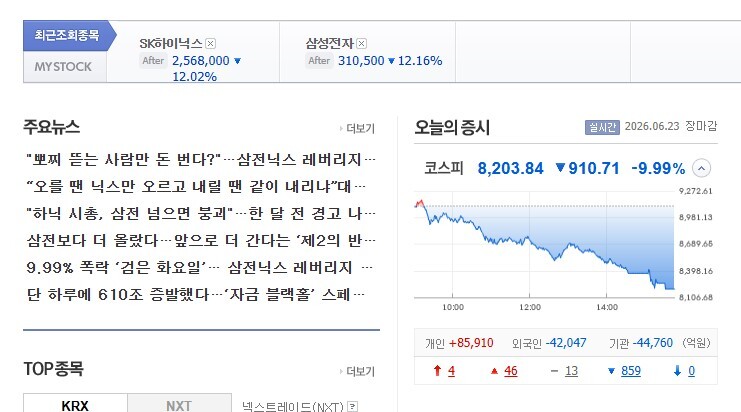
Just one day after closing at a record high above 9,100, the KOSPI plunged 9.99% to finish around 8,204 — the largest point drop in the index’s history. The decline was so violent that the exchange triggered a circuit breaker (the fourth this year) and sell sidecars on both the main board and the KOSDAQ.
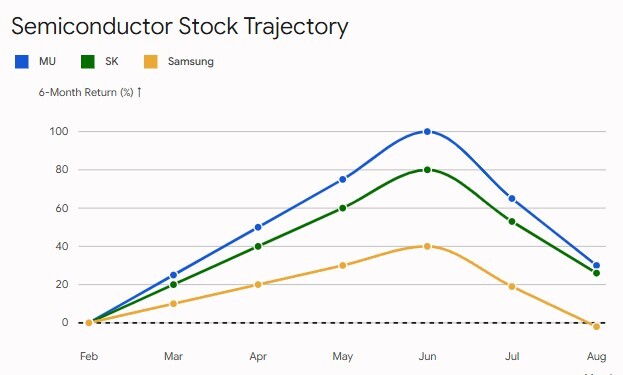
At the center of it were the same two names that drove the market up: Samsung Electronics fell about 12.3% and SK Hynix about 12.5% — their worst single-day drops since the 2008 financial crisis. Those two stocks alone shed roughly 520 trillion won in value in one session, and the broader market lost over 700 trillion won. Tellingly, Korea was the only major Asian market to fall this hard. Analysts didn’t blame a macro shock or broken fundamentals; they called it a reversal of extreme concentration in semiconductor mega-caps. That diagnosis is the whole lesson.
Why One Day Erased Months of Gains: Concentration Risk
Here’s the structural truth I keep coming back to. Samsung and SK Hynix together make up more than half of the entire KOSPI. When two companies effectively are the index, their bad day isn’t just their problem — it’s everyone’s catastrophe. The two memory giants dropped around 12%, and because of their enormous combined weight, they dragged the whole index down nearly 10% with them. There simply weren’t enough other stocks large enough to cushion the fall.
It’s worth adding that this fragility had been building. In recent weeks, a wave of single-stock 2x leverage products tied to Samsung and SK Hynix had pulled in floods of retail money, magnifying every move in these two names — something Korea’s financial regulator had explicitly warned about just days earlier. When a market is already top-heavy and you pile leverage on top of its two heaviest stocks, days like today become almost inevitable.
The US Contrast: Why Diversification Cushions the Blow
Now compare that to how the US market absorbs the same kind of shock. If a major chip stock like Micron or Intel fell 10% on a given day, the Nasdaq-100 — which I access through QQQ-style funds — would likely fall only about 2–3%. Why? Because hundreds of companies across many different sectors are holding the index up at the same time. No single name can sink the whole ship.
Flip it around and the contrast is even starker: for a broad US index like that to fall a full 10%, you’d typically need many individual stocks down 20–30% all at once. Breadth acts as a shock absorber. In Korea, that absorber barely exists, because the “market” is really just two semiconductor stocks wearing an index costume.
How I Build My Portfolio Around This
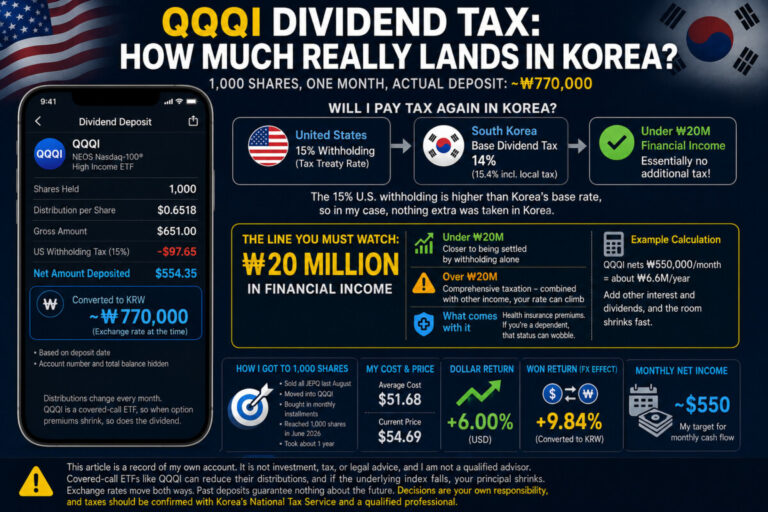
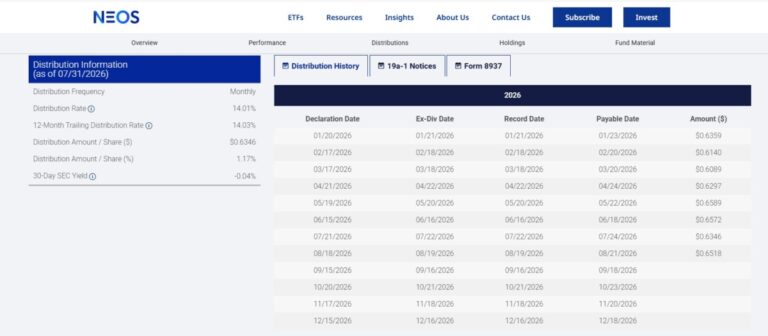
This is exactly why my portfolio is structured the way it is. On the US side, I build the skeleton of my entire portfolio with broad, diversified funds like QQQM and QQQI. They spread my money across the whole Nasdaq-100, so a bad day in any one company rarely threatens the structure. It takes a lot to make a diversified base like that truly collapse.
For Korea, I’ve gone even further on caution: I hold no individual Korean stocks at all — only KOSPI 200 covered-call ETFs. In theory, owning the broad index should protect me. And yet today, even that “safe,” diversified Korean position fell close to 10%, because the index I’m tracking is itself dangerously concentrated. That’s the cruel irony of Korean index investing right now: diversifying across the index doesn’t save you when the index is two stocks. It’s the core reason I deliberately keep my Korean allocation small — around a fifth of my assets — while the majority stays in the deeper, broader US market.
The Honest Takeaway: Korean Investing Is Still Hard
I want to be fair here. Today’s crash was widely described as a technical correction rather than a sign of broken fundamentals, and Korean retail investors actually bought the dip in record size. This isn’t doom, and it isn’t Korea-bashing. But it is a hard structural reality: even when you invest in Korea the careful way — broad, diversified, no single-stock gambling — a single bad day for two semiconductor giants can wipe out months of gains. Until the Korean market broadens out beyond Samsung and SK Hynix, this concentration risk is simply the price of admission. And that, more than anything, is why I sleep better with most of my money on the other side of the Pacific.
Final Thoughts
A 10% crash is never fun to watch. But for me, today’s KOSPI crash was less a disaster than a confirmation: diversification isn’t an abstract textbook concept — it’s the thing that decides whether one bad day dents your portfolio or guts it. I’ll keep my US skeleton broad, my Korean exposure small and managed, and my respect for concentration risk very, very high.
Investment Disclaimer
This article reflects personal opinions and observations only. It is not financial, investment, tax, or legal advice, and I am not a licensed financial advisor. Diversification can reduce certain risks but does not guarantee against loss — broad US indexes can and do fall sharply too, and past patterns may not repeat. Nothing here is a recommendation to buy or sell any security or fund. Past performance does not guarantee future results, and all investing carries the risk of loss, including the loss of your entire principal. Please do your own research and consult a qualified, licensed professional before making any investment decision.