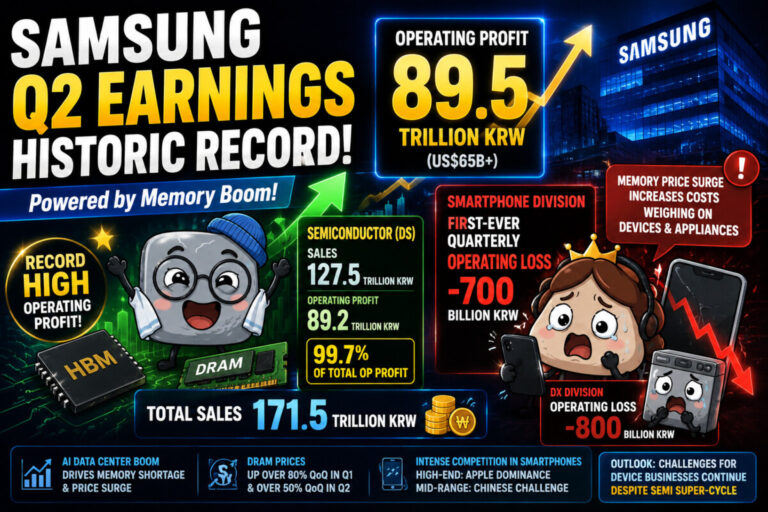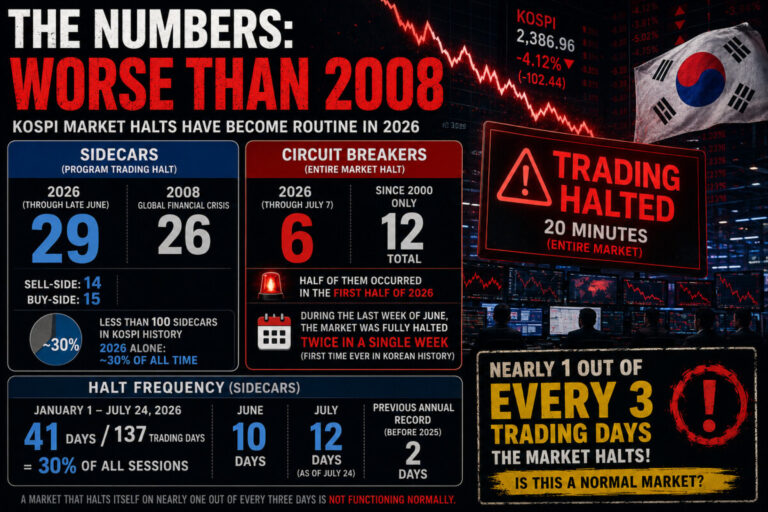
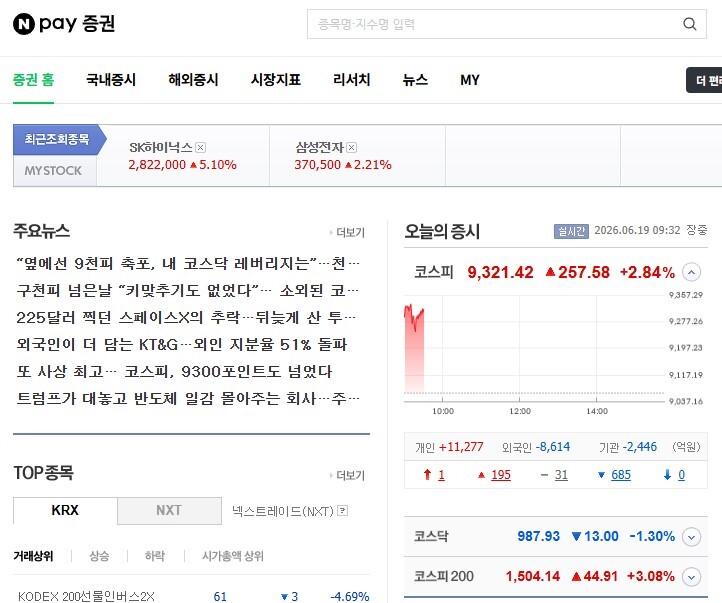
In June 2026, the KOSPI 9000 milestone made headlines — Korea’s main stock index crossed 9,000 points for the first time in history, roughly doubling within a single year. On the surface it looks spectacular, like the whole country is suddenly rich. But living here and investing here, I see something most of those headlines gloss over: this record isn’t really about “Korean stocks.” It’s about exactly two companies — Samsung Electronics and SK Hynix.
Let me explain why the KOSPI 9000 story is far narrower than it looks, and why most Koreans aren’t actually celebrating.
KOSPI 9000 Is a Tale of Two Stocks
The index hit its milestone, but the gains underneath it were extraordinarily concentrated.
Samsung and SK Hynix Are More Than Half the Index
As of mid-2026, Samsung Electronics and SK Hynix together make up well over half of the entire KOSPI by market value — around 54%, up from roughly 34% at the end of the previous year. Samsung sits in the high-20s percent range and SK Hynix has surged into the low-to-mid 20s on the back of the AI memory (HBM) boom. The top ten stocks now account for around two-thirds of the whole market. In other words, when you hear “KOSPI hit 9,000,” what really happened is that two semiconductor giants soared and dragged the index up with them.
Who Actually Made Money
This concentration has a brutal implication: the only Korean investors truly winning from KOSPI 9000 are the slice of people who held Samsung and SK Hynix. If your money was in almost anything else, your portfolio likely didn’t double the way the index did. Tellingly, while the KOSPI broke records, the smaller-cap KOSDAQ market slid below the 1,000 line around the same time — money rushed into a handful of mega-cap semiconductors and away from everything else. A rising index masked a very lopsided reality.
Why Most Koreans Aren’t Celebrating
Beyond the concentration problem, there’s a deeper cultural reason the stock market boom doesn’t reach most households: Koreans, by and large, don’t invest in stocks the way they invest in property.
The “Real Estate Always Wins” Mindset
In Korea, there’s a powerful, almost unshakeable belief that real estate is the guaranteed path to wealth. Nearly everyone has a relative or neighbor who grew rich simply by buying an apartment and holding it for years. That lived experience hardened into a national conviction: own property long enough and you will get rich. Real estate feels safe, tangible, and proven.
The “Stocks Are Gambling” Stigma
The flip side is just as strong. Many Koreans view the stock market as gambling — a fast way to “blow it all” and end up with an empty account. Because of that stigma, fewer people invest in stocks than you’d expect in such a wealthy, tech-savvy country. Those who do often commit only small amounts, and even fewer hold for the long term. The mindset is “dabble cautiously, then get out,” which is almost the opposite of the patient, decades-long approach that builds real stock-market wealth.
The Vicious Cycle: Stock Profits Flow Back Into Property
Here’s the pattern that really stands out to me. Even Koreans who do make money in stocks frequently take those profits and pour them straight into real estate. The stock market becomes a temporary stop, not a destination. Capital that could compound in equities for decades instead gets cycled back into apartments, reinforcing the very “property is king” belief that started the whole loop. It’s a self-perpetuating cycle that keeps the nation’s wealth concentrated in real estate — and keeps the stock market underused as a tool for ordinary people.
How I Invest in Korean Stocks
This whole picture is exactly why I handle my Korean investments the way I do. I don’t pick individual Korean stocks at all. Instead, my entire Korean allocation goes into a single product: KODEX 200 Target Weekly Covered Call, an ETF that tracks the KOSPI 200 and generates income through a covered-call strategy. Given how concentrated and sentiment-driven this market is, I’d rather hold the broad index with an income overlay than try to time individual names. It’s my way of staying exposed to Korea without betting on any one company in a market dominated by just two.
A Generational Shift Is Quietly Starting
It’s not all stagnation, though. Among younger Koreans, attitudes toward investing are genuinely changing. More and more young people see stocks not as gambling but as a legitimate, necessary path to building wealth — especially as sky-high property prices put traditional real estate further out of reach. I count myself as part of that shift. The old “real estate or nothing” mindset is loosening, slowly, and a new generation is starting to treat long-term investing as normal. That cultural change may end up mattering more than any single index milestone.
Final Thoughts
KOSPI 9000 is a real, historic number — but it’s a headline that hides as much as it reveals. It was powered by two semiconductor titans, it left most other investors behind, and it landed in a culture that still trusts apartments far more than equities. Understanding that gap between the index and the reality is, I think, the key to actually understanding the Korean market.
Investment Disclaimer
This article reflects personal observations and opinions only. It is not financial, investment, tax, or legal advice, and I am not a licensed financial advisor. Index milestones and the popularity of specific assets — whether stocks or real estate — say nothing about what will perform well in the future, and a highly concentrated market can fall as sharply as it rose. The ETF mentioned describes my own approach, not a recommendation, and covered-call ETFs carry their own risks including capped upside and possible erosion of principal. Past performance does not guarantee future results, and all investing carries the risk of loss, including the loss of your entire principal. Please do your own research and consult a qualified, licensed professional before making any investment decision.