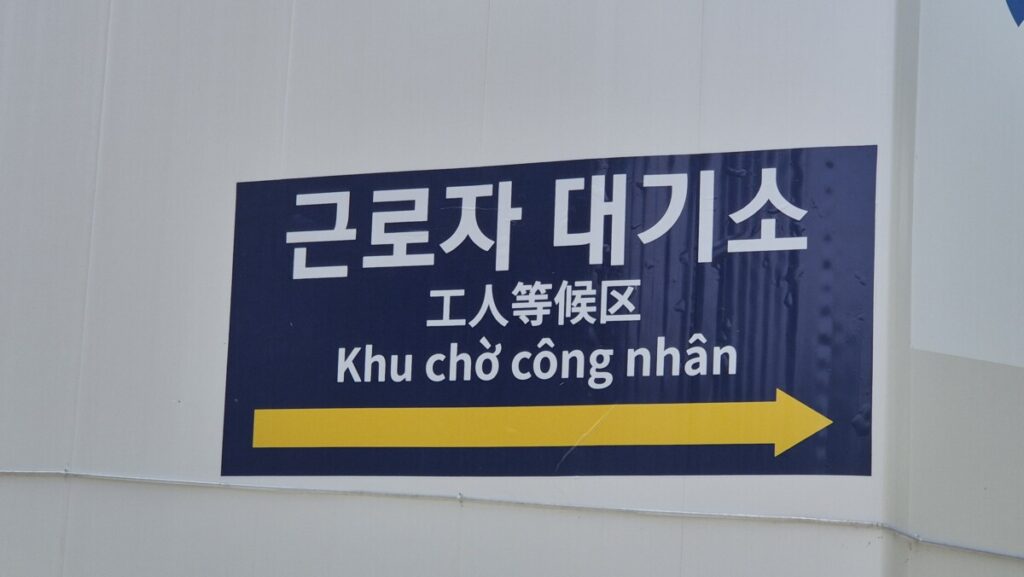
I was out walking today when a sign on a construction site stopped me. It read “Worker Waiting Area” — but not just in Korean. The same words appeared in Chinese (工人等候区) and Vietnamese (Khu chờ công nhân). That single trilingual sign tells you almost everything you need to know about South Korea’s labor shortage and who is quietly keeping the country’s hardest jobs running. As someone living here and investing here, it set off a chain of thoughts about crisis, opportunity, and where Korea is headed in the AI era. Let me share them.
A Sign That Says Everything: Who Actually Does the Hard Work
That sign wasn’t an accident. A while back, I spent a day helping an older friend at his scrapyard, and I noticed something striking: almost every owner was Korean, but almost every worker was a foreigner. The trilingual construction sign is the same story written on a wall.
The numbers back up the impression. Foreign workers now make up roughly 10% of Korea’s manufacturing workforce, brought in largely through the Employment Permit System (the E-9 visa), which recruits labor from 16 Asian partner countries — Vietnam, China, Nepal, Cambodia, the Philippines, and more. On the country’s factory floors, construction sites, farms, and scrapyards, foreign hands increasingly do the work that keeps the economy physically moving.
The Root: A Low-Birthrate Nation That Avoids “3D” Jobs
Why? Two forces collide. First, Korea has the lowest birthrate in the world — its fertility rate fell to around 0.72 births per woman in 2023, far below the level needed to sustain a population. The workforce is literally shrinking; one state report projects Korea will be short more than 800,000 workers by 2033, with over half a million job vacancies already unfilled across manufacturing, construction, caregiving, and logistics.
Second, Korea is now a wealthy, highly-educated developed country — about 69% of young adults have a tertiary education, the highest rate in the OECD. When nearly everyone has a university degree, almost no one wants the “3D” jobs: dirty, dangerous, and difficult. Young Koreans overwhelmingly chase office work, and the physically demanding roles get left behind — to be filled, increasingly, by foreign workers. This, to me, is the structural knot at the heart of modern Korea: a society that out-educated its own willingness to do hard physical labor, while having too few children to replace its workforce.
https://keia.org/the-peninsula/are-foreign-workers-a-solution-to-koreas-demographic-challenge
The Flip Side: The Most Wired Country on Earth
But here’s where the story turns, and why I don’t think it’s all doom. Korea may be small, but that smallness is a hidden superpower when it comes to infrastructure. The country is one of the most wired on the planet — blazing-fast internet reaches virtually everywhere, and Korea was among the very first nations to roll out nationwide 5G. A compact, dense, tech-obsessed country can deploy new infrastructure faster and more completely than almost anywhere else.
That matters enormously, because it means Korea reacts to new technology with unusual speed and sensitivity. When a new tech wave arrives, Korea doesn’t just dip a toe — it dives, nationwide, almost overnight.
Crisis and Opportunity at the Same Time
So Korea sits in a genuinely paradoxical position. On one side is a slow-motion demographic crisis serious enough that some economists warn it could drag the country toward negative growth by the 2050s if nothing changes. On the other side is a nation with world-class digital infrastructure, an intensely tech-adoptive culture, and deep industrial expertise. Risk and opportunity, braided together. The question is which one wins.
Why the AI Era May Tilt Korea Toward Opportunity
Here’s my central thesis. We are entering an age where technology and knowledge matter more than sheer human labor. And if the future rewards tech capability over headcount, then a country that is short on workers but rich in infrastructure, education, and engineering might be unusually well-positioned — if it leans into automation hard enough.
The signs are already there. Korea is pivoting its immigration toward skilled talent (the E-7 visa and a new “Top-Tier Visa” aimed at semiconductors, AI, batteries, biotech, and robotics). And the same Physical AI and robotics revolution I’ve written about before could directly fill the 3D-labor gap that foreign workers fill today — robots doing the dirty, dangerous, difficult work that young Koreans avoid and that the shrinking population can’t staff. In other words, Korea’s biggest weakness (too few workers) is exactly the problem automation is built to solve. For the next while, I think the AI era hands Korea a bigger opportunity than crisis.
The Investment Insight
For me, this all points to a clear way to think about Korean exposure: Korea is essentially a leveraged bet on technology solving its own demographic problem. The country’s market is dominated by the very tools of that solution — AI memory chips (Samsung, SK Hynix), and a growing ecosystem of robotics and automation players. The demographic crisis isn’t just a risk to underwrite; it’s the forcing function pushing Korea to adopt automation faster than countries that still have plentiful cheap labor.
That said, I respect the risks enough to stay disciplined. Korea’s market is dangerously concentrated, its openness to foreign professionals is still among the lowest in the OECD, and demographic decline is a powerful long-term headwind. So I personally keep my Korean exposure modest and broad — a KOSPI 200 covered-call ETF rather than individual bets — while keeping the majority of my capital in the US. I want exposure to Korea’s tech-driven upside without betting everything on a single demographic gamble.
Final Thoughts
A trilingual “Worker Waiting Area” sign is a tiny window into a huge story: a rich, shrinking, highly-educated country that has outsourced its hardest labor and now faces a choice. Double down on importing workers, or leap into an automated, AI-driven future its world-class infrastructure is uniquely ready for. I’m betting Korea leans into the technology — and I’m positioning, carefully, for the possibility that it works.
Investment Disclaimer
This article reflects personal opinions and observations only. It is not financial, investment, tax, or legal advice, and I am not a licensed financial advisor. Macro and demographic theses are uncertain and can take decades to play out — or fail to. The holdings and allocation I mention describe my own approach, not recommendations, and a concentrated market like Korea’s carries real risk. Past performance does not guarantee future results, and all investing carries the risk of loss, including the loss of your entire principal. Please do your own research and consult a qualified, licensed professional before making any investment decision.