Yesterday I sat through SK Hynix’s earnings call feeling frustrated. The company posted ₩60 trillion in operating profit — a genuinely historic number — and the stock fell anyway. This morning at 10 a.m., Samsung Electronics held its own conference call. Same memory market, same AI cycle, one day apart. The reaction was the exact opposite. The Samsung vs SK Hynix earnings comparison over these two days taught me more about how markets actually work than any textbook has.
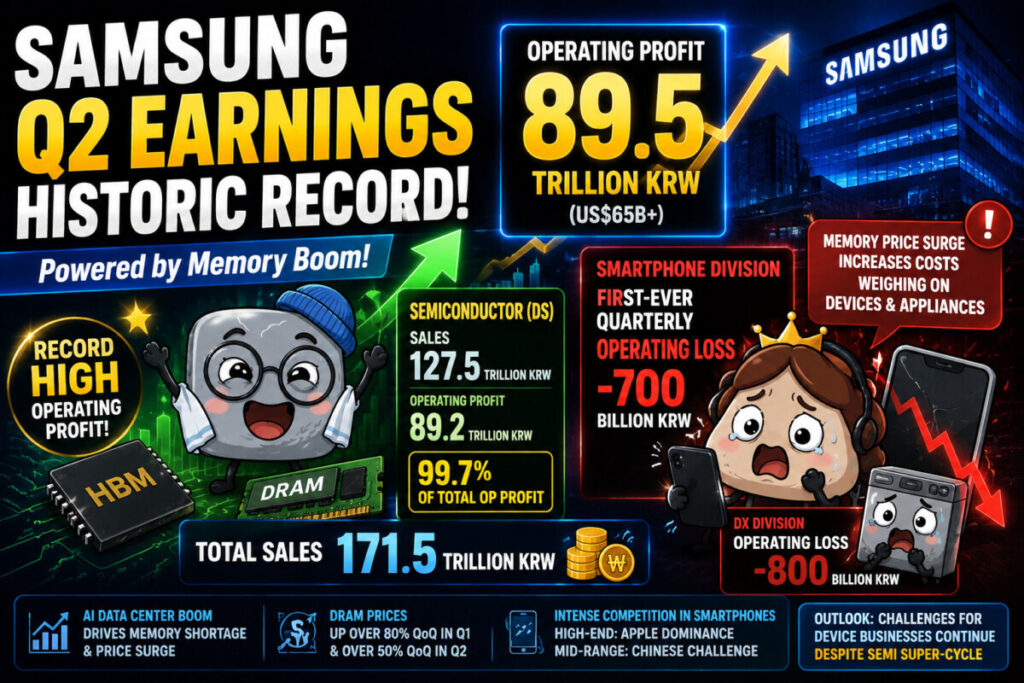
Samsung’s Numbers
Let’s start with the confirmed results:
- Revenue: ₩171.5 trillion
- Operating profit: ₩89.5 trillion
- Quarter-over-quarter: revenue +28%, operating profit +56%
- Year-over-year: revenue +130%, operating profit +1,814%
That’s a record quarter on both lines. Last year’s Q2 operating profit was around ₩4.7 trillion; this year it’s ₩89 trillion. Roughly nineteen times higher.
The divisional breakdown makes the picture sharper. Semiconductors (DS) brought in ₩127.5 trillion in revenue and ₩89.2 trillion in operating profit. The finished-products division (DX) posted a ₩0.8 trillion loss. Of ₩89.5 trillion in total operating profit, ₩89.2 trillion came from chips. Semiconductors carried the entire company while smartphones and appliances lost money.
There’s an eye-opening footnote too: this figure already absorbs roughly ₩17 trillion in employee bonus provisions that piled into this quarter after prolonged labor negotiations pushed them out of Q1. Strip that out and Samsung’s true operating profit for the quarter exceeds ₩100 trillion.
Why Samsung Rose: It Beat Expectations
Here’s where the decisive difference from yesterday emerges, and it’s almost embarrassingly simple.
The consensus estimate for Samsung’s operating profit was around ₩85 trillion. Actual: ₩89.5 trillion. A ₩4.5 trillion beat.
SK Hynix yesterday was the exact inverse. Consensus: ₩64.7 trillion. Actual: ₩60.5 trillion. A ₩4.2 trillion miss.
The absolute magnitude of Samsung’s number dwarfs Hynix’s. But what moved the stocks wasn’t magnitude — it was direction relative to expectations. Two companies, both posting historic profits, both riding the same supercycle, and one gets punished while the other gets rewarded.
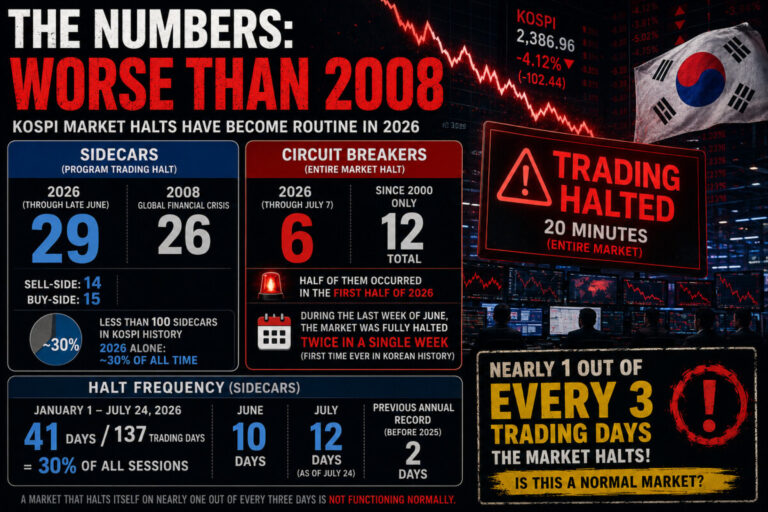
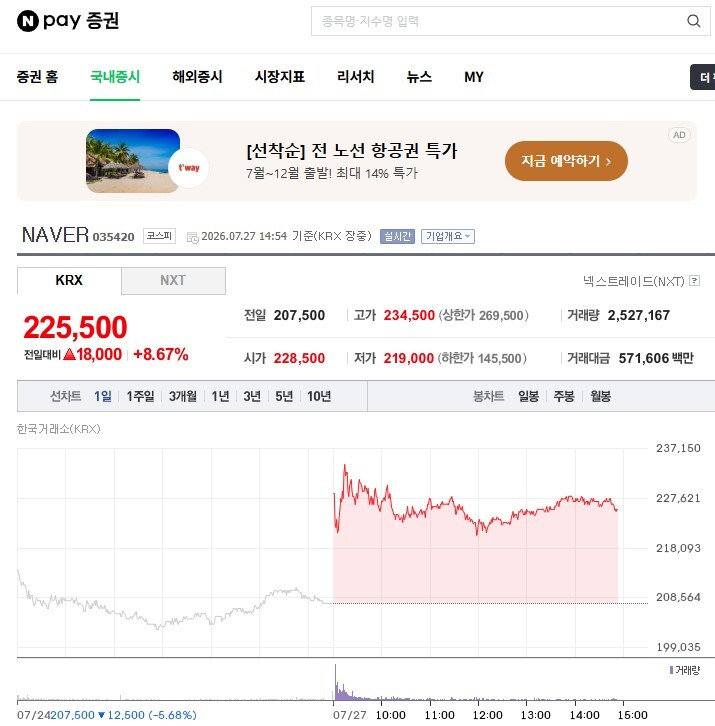
Two other factors helped Samsung. The market was deeply oversold going in — Korea saw circuit breakers on two consecutive days this week, with the KOSPI dropping over 9% in a session and both memory giants falling nearly 14%. The situation got severe enough that the Finance Minister publicly apologized in the National Assembly for allowing single-stock leveraged ETFs. In that context, a strong number becomes a justification for a bounce. And as noted, Samsung delivered ₩89 trillion while absorbing that ₩17 trillion bonus charge.
Side by Side
| Samsung (7/30) | SK Hynix (7/29) | |
|---|---|---|
| Revenue | ₩171.5T | ₩79.3T |
| Operating profit | ₩89.5T | ₩60.5T |
| Consensus | ₩85T | ₩64.7T |
| vs. expectations | +₩4.5T (beat) | −₩4.2T (miss) |
| Operating margin | ~70% (semis) | 76% |
| Stock reaction | Rebound | Decline |
The table reveals something counterintuitive. Samsung wins decisively on absolute scale — 1.5× the operating profit, more than 2× the revenue. But Hynix still wins on profitability: a 76% operating margin, higher than Samsung’s semiconductor division and higher than TSMC, because Hynix concentrates on high-value HBM.
And yet the stocks moved opposite to that ranking. The market doesn’t price absolute profitability. It prices the gap between what it expected and what it got.
The Structural Difference Beneath the Numbers
Beyond expectations, the two companies have genuinely different constitutions.
Hynix is HBM-concentrated. That’s both its strength and its vulnerability. When HBM sells well, it produces overwhelming margins. But the moment doubt creeps in — what if AI investment slows? — that same concentration becomes pure risk. Yesterday’s disclosure that DRAM average selling price growth decelerated from +65.9% in Q1 to +28.9% in Q2 poured fuel on exactly that doubt.
Samsung has breadth. Beyond HBM, it has conventional DRAM, NAND, LPDDR, foundry, plus smartphones and appliances. Samsung has long been criticized for trailing Hynix in the HBM race, but in a moment when investors are worrying about “life after HBM,” that breadth becomes defense. Expectations that Nvidia’s next-generation GPUs will lift LPDDR demand play directly to Samsung’s favor.
Samsung has its own weakness, of course — that ₩0.8 trillion loss in finished products. Chips are earning so much that it’s buried in the headline, but smartphones and appliances failing to make money is worth noting.
What I’m Watching Next
Three things, in order.
DRAM price growth. Does the deceleration Hynix confirmed (65.9% → 28.9%) continue into Q3? Prices are still rising, but if the pace keeps slowing, the market reads “cycle peak.” If it re-accelerates, this correction gets reinterpreted as an overreaction.
HBM4 supply and long-term agreements. Durability now matters more than the absolute size of any quarter. More LTAs mean less of memory’s chronic earnings volatility. Whether Samsung locks in HBM4 supply to Nvidia is a major variable.
Big Tech AI capex. Everything traces back here. Microsoft and Meta have reported; Amazon and Apple remain. If they signal continued AI investment, much of the current fear dissolves. If not, earnings won’t matter — the stocks won’t move.
There’s also the China CXMT variable in the background. CXMT can’t obtain EUV equipment, which sharply limits its ability to produce high-performance HBM, and its share sits around 8%. Not enough to flip the board today, but enough to keep pressuring sentiment in commodity DRAM.
What This Says About Korea’s Market — An Honest Reflection
Here’s the part that sits uncomfortably with me as a Korean investor.
Two companies posted the best quarterly results in their histories. Samsung’s operating profit exceeded Nvidia’s and Apple’s. And the Korean market spent the same week hitting circuit breakers on consecutive days, with the index down 9% in a session and the Finance Minister apologizing to parliament.
That contrast tells me something I keep relearning: Korea’s market fundamentals are weaker than its headline numbers suggest. Not because these companies are weak — they’re extraordinary. But because a national stock market where two semiconductor firms make up roughly 40% of the KOSPI 200 (and over 60% of the broader KOSPI including preferred shares) isn’t really a market. It’s a leveraged bet on one industry’s cycle, wearing a national benchmark’s clothing.
When one company misses consensus by ₩4 trillion — while still earning ₩60 trillion — the entire country’s index convulses. That’s not a healthy structure. A mature market absorbs a single company’s disappointment; ours amplifies it into a circuit breaker. And the recent introduction of single-stock leveraged ETFs on exactly these two names took a concentrated market and made it unstable, which is precisely why the Finance Minister ended up apologizing.
I don’t say this to bash my own country. I say it because it’s the honest reason my portfolio is roughly 80% US equities and 20% Korean. It isn’t that I doubt Samsung or Hynix. It’s that I don’t want my financial future determined by whether one memory cycle decelerates from 65.9% to 28.9%.
Where That Leaves Me
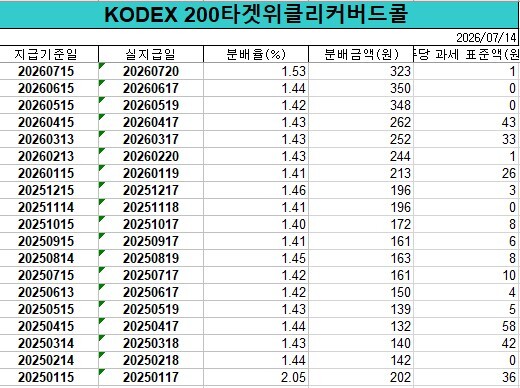
I’m exposed to both stocks through KOSPI 200 covered-call ETFs, since the two of them make up close to 40% of that index. So yesterday I fell with them and today I caught my breath with them.
What I can do here isn’t prediction — it’s response. I’ll watch how DRAM price growth prints next quarter, whether LTAs expand, and whether Big Tech keeps spending. Until then, I’ll keep doing what I’ve been doing: collecting the monthly distributions and adding a little to my share count on the way down.
Final Thoughts
The Samsung vs SK Hynix earnings split over two days is the cleanest lesson I’ve seen this year: within the same industry, stocks move not on the size of profits but on the distance between profits and expectations. Hynix carried expectations that were too high; Samsung’s were relatively low. So the company that earned ₩60 trillion fell, and the one that earned ₩89 trillion rose — both after record quarters.
Investment Disclaimer
This article reflects personal opinions and analysis of publicly reported information. It is not financial, investment, tax, or legal advice, and I am not a licensed financial advisor. Earnings reactions are unpredictable, concentrated markets carry elevated risk, and the holdings I describe are my own rather than recommendations. Past performance does not guarantee future results, and all investing carries the risk of loss, including the loss of your entire principal. Please do your own research and consult a qualified, licensed professional before making any investment decision.