Nvidia doesn’t usually buy equity stakes in foreign internet companies. So when news broke today that the Nvidia Naver stake would make the chip giant Naver’s third-largest shareholder, it caught my attention immediately. This isn’t a routine supply agreement — it’s a $1 billion equity investment tied to a $10 billion AI infrastructure project, and it tells you a lot about how the AI buildout is spreading beyond America’s borders. Here’s what happened, why Nvidia did it, and what each side actually gets.
The Deal: $1 Billion for 4.5% of Naver
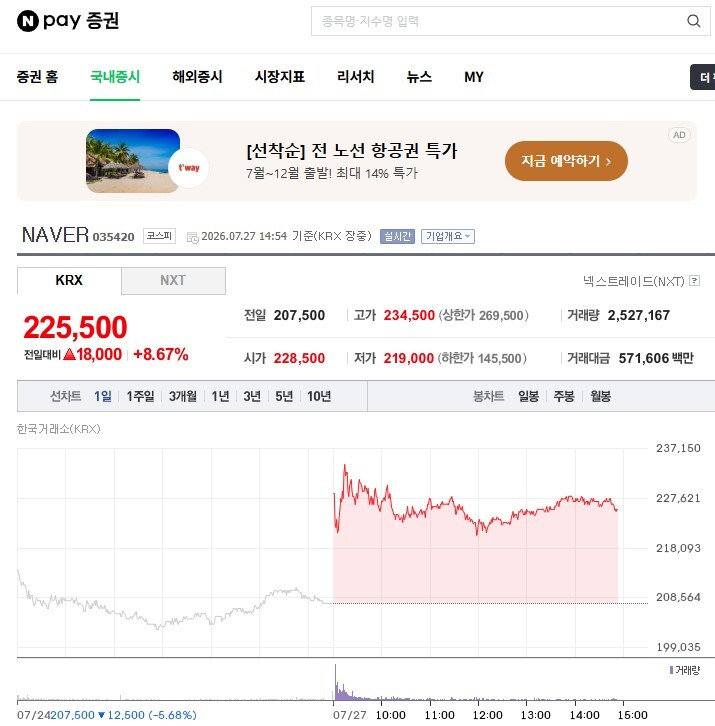
Naver disclosed on July 27 that it will issue 7,241,564 new common shares to Nvidia through a third-party allocation rights offering, priced at ₩204,500 per share — raising approximately ₩1.4809 trillion, or $1 billion. That gives Nvidia a 4.5% stake, making it Naver’s third-largest shareholder behind Korea’s National Pension Service and BlackRock. Payment is due October 30.
Two details make this more remarkable than the headline numbers. First, this is the first third-party allocation offering Naver has done since it moved to the KOSPI main board in 2008 — 22 years. Second, Naver is simultaneously retiring 4,901,094 treasury shares worth about ₩1.017 trillion on August 3, meaning the company is offsetting much of the dilution with a buyback-and-cancel program. Existing shareholders aren’t simply being diluted; they’re getting a partial cushion.
The Bigger Picture: A $10 Billion AI Factory
The equity stake is really the smallest piece of a much larger structure. On July 24, at an AI Summit in San Francisco, Naver, Nvidia, and Brookfield jointly announced an expansion of Korea’s sovereign AI factory infrastructure.
The project totals $10 billion: Nvidia invests $1 billion strategically, Brookfield participates as exclusive capital partner arranging up to $9 billion in project financing, and Naver covers the remainder. The physical target is Naver’s hyperscale data center GAK Sejong, where the previously announced 55MW Nvidia DSX-based AI factory will be scaled up nearly fourfold to 200MW, housing roughly 100,000 GPUs — built on Nvidia’s Blackwell and next-generation Vera Rubin platforms, targeted for completion by 2028. GAK Sejong is designed to supply up to 270MW of power across a 294,000㎡ site, and Naver plans to eventually scale this toward gigawatt-class infrastructure.
Critically, it will operate as a multi-tenant facility, serving not just Korean companies but American AI firms as well.
https://www.hankyung.com/article/202607277664i
Why Nvidia Did This: Four Strategic Reasons
1. Locking In Demand, Not Just Making a Sale
Nvidia could have simply sold GPUs to Naver. Taking equity instead ties its fortunes to the buildout succeeding. A 200MW facility with 100,000 GPUs is enormous, and an equity stake ensures Nvidia is a partner in the project’s long-term expansion — including the stated ambition to reach gigawatt scale — rather than a vendor who gets one order and moves on.
2. A Beachhead in Asia’s Sovereign AI Market
“Sovereign AI” — the idea that nations need domestically-controlled AI infrastructure rather than depending on foreign clouds — has become one of Jensen Huang’s most consistent talking points. Korea is an ideal proving ground: technically advanced, politically aligned with the US, and actively pursuing national AI capability. This deal was announced alongside President Lee Jae-myung’s visit to the San Francisco AI Summit, which underscores how much national policy sits behind it.
3. Diversifying Beyond the Hyperscalers
Nvidia’s revenue is heavily concentrated in a handful of US hyperscalers. Every dollar of demand that comes from a different kind of buyer — a national champion in a foreign market building multi-tenant capacity — reduces that concentration risk. If the market ever questions whether Microsoft or Meta will keep spending, having Naver-type customers in the mix matters.
4. Full-Stack Lock-In
This isn’t just GPUs. The facility runs on Nvidia DSX, a platform integrating GPUs, networking, storage, power, and cooling. And on the software side, Naver is enhancing its HyperClova X model based on Nvidia’s Nemotron 3 Ultra open model. Chips, infrastructure platform, and model foundation all flow from Nvidia — the deepest form of ecosystem lock-in.
What Naver Gets: The Synergies
Capital at Unprecedented Scale
Chairman Lee Hae-jin framed it directly, saying that with Nvidia’s strategic investment and the Brookfield infrastructure agreement, Naver’s AI factory vision has entered genuine execution. This is the largest external funding in the company’s history. For a Korean internet company to raise $10 billion for infrastructure would have been unthinkable a few years ago.
GPU Access in a Shortage Market
This might be the single most valuable item. GPUs are the scarcest resource in technology right now, and allocation matters more than money. Having Nvidia as a shareholder — not merely a supplier — moves Naver to the front of a very long line. In an environment where compute capacity determines competitive position, that’s close to strategic gold.
A Pivot From AI Services to AI Infrastructure
The strategic significance here is that Naver is expanding from being an AI service company into an AI infrastructure provider. As CEO Choi Soo-yeon put it, this investment creates the opening for Naver to enter the global AI infrastructure market using its own technology and facilities. As generative AI competition shifts from model performance toward securing computing infrastructure, Naver is positioning itself with its own models, data centers, cloud, and GPU infrastructure — a full-stack AI factory operator.
Global Brand and Network Validation
Lee Hae-jin noted that beyond capital, the global brand and networks these two companies bring represent a major opportunity to extend Naver’s capabilities. Having Nvidia on the shareholder register is a credibility signal to every potential international customer of that multi-tenant facility.
The Risks Worth Noting
I want to keep this balanced. The deal is contingent on completing regulatory procedures and financing — Brookfield’s $9 billion is still in final contract negotiations, and Naver’s own investment amount hasn’t been disclosed. A 2028 completion target is far enough out that a lot could change, particularly if AI capex enthusiasm cools. And 4.5% is a meaningful stake but not control, so anyone imagining Nvidia will steer Naver’s strategy is overreading it. There’s also the broader question hanging over every AI infrastructure project right now: these are enormous upfront costs against revenue that arrives years later, in a market that has recently grown impatient with exactly that profile.
Final Thoughts
The Nvidia Naver stake is a small piece of a much bigger story — the globalization of AI infrastructure. Nvidia is buying a permanent seat at the table of Asia’s sovereign AI buildout; Naver is buying capital, GPU access, and a transformation from portal company to infrastructure operator. Whether it pays off depends on whether 100,000 GPUs in Sejong find enough paying tenants by 2028. But as a statement of where the AI buildout is heading next, it’s hard to ignore.
Investment Disclaimer
This article organizes publicly reported information and reflects personal opinion only. It is not financial, investment, tax, or legal advice, and I am not a licensed financial advisor. The transaction described remains subject to regulatory approval and financing completion, and announced investment plans can be delayed, revised, or cancelled. Nothing here is a recommendation to buy or sell any security. Past performance does not guarantee future results, and all investing carries the risk of loss, including the loss of your entire principal. Please do your own research and consult a qualified, licensed professional before making any investment decision.