Another day, another sell-side sidecar. This morning Samsung Electronics and SK Hynix both plunged, the KOSPI cratered, and trading curbs kicked in yet again. At this point KOSPI volatility has stopped being news and started being the weather. But when I looked up the actual numbers this year, I was genuinely shocked — Korea’s market has now blown past every volatility record it set during the 2008 global financial crisis. Here’s what the data says, why it’s happening, and why I think it matters more than any single day’s drop.
The Numbers: Worse Than 2008
Let me start with the statistic that stopped me cold.
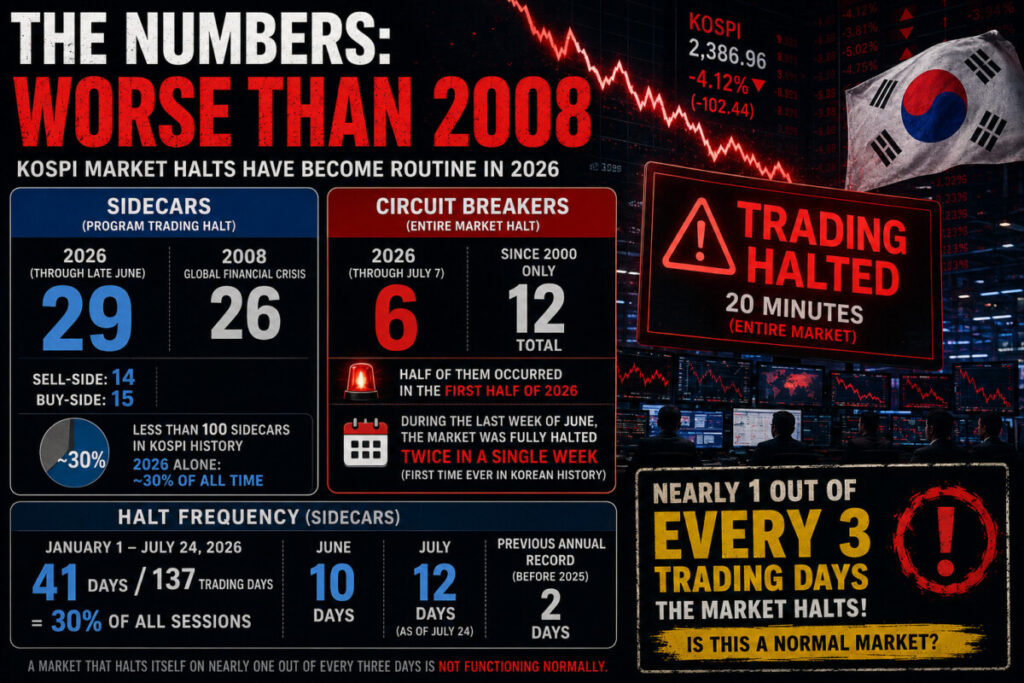
Through late June, the KOSPI had triggered 29 sidecars this year — 14 sell-side and 15 buy-side — the most since the mechanism was introduced. For comparison, the entire 2008 global financial crisis produced 26. The KOSPI’s cumulative all-time sidecar count sits somewhere under 100, meaning 2026 alone accounts for roughly 30% of every sidecar in Korean market history.
It gets worse. Circuit breakers — which halt the entire market for 20 minutes, not just program trading for 5 — have fired six times this year through July 7. Since 2000, the KOSPI has seen only 12 circuit breakers total. Half of them happened in the first half of 2026. During the last week of June, trading was fully halted twice in a single week, a first in Korean market history.
And the pace is accelerating, not fading. As of July 24, the KOSPI had triggered sidecars on 41 of 137 trading days this year — 30% of all sessions. June saw 10, July saw 12. Prior to 2025, the annual record was two.
A market that halts itself on nearly one out of every three days is not functioning normally.
What Today Looked Like
Today’s session fit the pattern exactly. A sell sidecar hit about six minutes after the open, with Samsung down over 6% and SK Hynix down more than 8%. Overnight, the Philadelphia Semiconductor Index had fallen 2.23%, Nvidia dropped 4.99%, and SK Hynix’s own American depositary receipts plunged 7.47% — so Seoul simply imported the damage at the opening bell.
The recent stretch has been brutal. On July 24, the KOSPI fell 5.72% to 6,690.62 with Samsung down 7.59% and SK Hynix down 8.34%, closing at ₩1,759,000 — a striking number when you consider the stock traded as high as ₩2,987,000 intraday on June 25. That’s roughly a 40% collapse in a month for Korea’s largest company by market value.
https://www.sedaily.com/article/20071660
Why This Keeps Happening: Three Structural Causes
1. Extreme Concentration
This is the root cause, and I’ve written about it before. Samsung Electronics and SK Hynix — common and preferred shares combined — now make up over 60% of the KOSPI. Add related companies like SK Square, Samsung Life, and Samsung C&T, and concentration reaches roughly 70%.
The mechanical consequence is unavoidable: when the memory sector drops 10%, it drags everything else down with it, and the index reaches circuit-breaker territory far more easily than in the past. Korea’s “market” has effectively become a two-stock index wearing a national benchmark’s costume. Diversifying across the KOSPI doesn’t protect you when the KOSPI is two semiconductors.
2. Single-Stock Leveraged ETFs
Here’s the accelerant that turned a concentrated market into an unstable one. Since single-stock leveraged ETFs on Samsung Electronics and SK Hynix launched on May 27, extreme volatility simply hasn’t subsided. From July 15 onward, the KOSPI triggered a sidecar every single day except one.
The mechanism is straightforward and ugly. Leveraged products amplify moves, forced liquidations cascade when they move against holders, and that cascade drives the underlying stocks further in the same direction — which triggers more liquidations. Korea’s financial regulator has publicly acknowledged concerns about these products, with the head of the Financial Supervisory Service reportedly expressing regret over how leveraged instruments fell 25% on a 10% index drop.
3. Retail Leverage Meeting Geopolitics
Layer on the macro. The US-Iran conflict has pushed oil sharply higher, Treasury yields to 2026 highs, and rate-hike expectations into the market. Every one of those headlines lands on a market that is structurally fragile and populated by leveraged retail positions. Domestic and foreign analysts have described Korea as caught in a “volatility trap” — a self-reinforcing cycle with no visible exit, created by structural dependence on a few semiconductor names combined with retail leverage and short-term trading.
Why I’m Genuinely Concerned
I want to be honest about what worries me here, because it isn’t the drops themselves. Markets fall; that’s normal. Three other things bother me more.
Safety mechanisms only work at extremes. Sidecars trigger at a 5% futures move, circuit breakers at 8%. If the market bleeds 4% a day, every day, no protection engages at all. The mechanisms catch the spectacular crashes and miss the slow grinding ones — and lately Korea has been experiencing both.
Normalization is dangerous. When trading halts happen on 30% of days, they stop signaling anything. Investors become numb, and a mechanism designed to force a pause and cool heads instead becomes background noise.
The structural problem isn’t being fixed. The consensus critique from analysts is that micro-level regulations and short-term fixes can’t stop sidecars and circuit breakers from becoming routine — without medium-to-long-term redesign of the index structure and derivatives rules, this kind of volatility shock will simply repeat. And I agree. You cannot regulate your way out of an index that is 70% dependent on one industry.
What I’m Doing About It
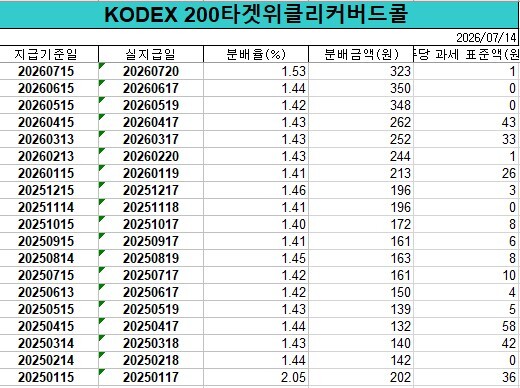
My response to all this isn’t complicated: I keep my Korean exposure deliberately small — around a fifth of my assets — and I hold it through KOSPI 200 covered-call ETFs rather than individual stocks. Even that hasn’t spared me, because the index itself is the concentrated thing. But sizing has meant that a 40% drawdown in SK Hynix dents my portfolio rather than defining it.
And I don’t own any leveraged products, in either market. Watching what happened in Korea after May 27 is the best argument against them I’ve seen in years.
Final Thoughts
The KOSPI volatility of 2026 isn’t a run of bad luck — it’s the predictable output of a market where two semiconductor stocks make up over 60% of the index and leveraged products amplify every move on both sides. Until that structure changes, Korea will keep setting records nobody wants: more circuit breakers than 2008, trading halts twice in a week, sidecars on a third of all sessions. As an investor, my only real defense is position sizing and the discipline not to reach for leverage in a market that’s already levered enough.
Investment Disclaimer
This article reflects personal opinions and analysis of publicly reported information. It is not financial, investment, tax, or legal advice, and I am not a licensed financial advisor. Highly concentrated and volatile markets carry substantial risk, and leveraged products in particular can lose value far faster than their underlying assets. Nothing here is a recommendation to buy or sell any security. Past performance does not guarantee future results, and all investing carries the risk of loss, including the loss of your entire principal. Please do your own research and consult a qualified, licensed professional before making any investment decision.