This month, my covered call ETF distribution did something that shouldn’t be possible at first glance. The payout from my KODEX 200 Target Weekly Covered Call dropped from 350 won per share to 323 won — a decline of about 7.7%. And yet, the fund’s actual distribution rate rose to its highest level in over a year. Lower check, higher rate. That sounds like a contradiction, but unpacking it tells you almost everything you need to know about how these income funds really work.
Quick note before we dive in: this is an informational breakdown of my own holding, not financial advice, and I’m not a licensed advisor. Do your own research.
The Number, and the Drop
Let’s start with the simple math. Last month (June), this ETF paid 350 won per share. This month (July), it paid 323 won — 27 won less per share, a drop of roughly 7.7%.
For me, this isn’t abstract, because I hold 2,000 shares. This month’s distribution works out to roughly 646,000 won, or about $430. One small scheduling note: the payout normally lands a couple of business days after the record date, but this month it arrives on Monday, July 20, instead. The reason is a fun piece of trivia — July 17 (Constitution Day) has been restored as a public holiday in Korea for the first time in 18 years, and since it falls on a Friday followed by the weekend, my payment simply rolls to the following Monday.
The 18-Month Distribution Trend
To really understand this month’s dip, you need to see the bigger picture. Here’s the payout history from the second distribution onward. (I’m excluding the very first payout — an unusual 202 won at a 2.05% rate — since it’s an outlier that would distort the trend.)
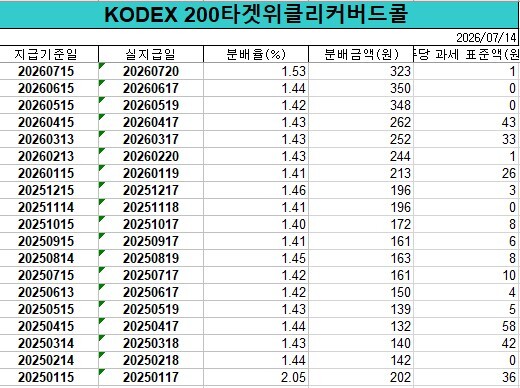
Look at the shape of that climb. From a low of 132 won in April 2025, the payout rose almost without interruption to a peak of 350 won in June 2026 — more than doubling, up roughly 165%, in about 14 months. This July is the first real pullback in that entire long climb.
The Paradox Explained: Why Lower Can Mean Higher Rate
So why did the payout more than double over that stretch? Here’s the key: through almost all of it, the fund’s distribution rate barely moved. It sat between about 1.40% and 1.46%, month after month — basically flat.
That means the growing won amount wasn’t coming from the fund suddenly paying a more generous rate. It was coming from the fund’s net asset value (NAV) rising, as the KOSPI 200 climbed and Korean memory stocks like Samsung and SK Hynix powered higher. A steady percentage of a growing base gives you a growing check. That’s the whole engine behind this fund’s covered call ETF distribution.
Which brings us to this month’s paradox. The distribution is, in effect, a percentage of the fund’s NAV. This month, the rate actually rose to 1.53% — its highest reading in over a year. And yet the payout still fell to 323 won.
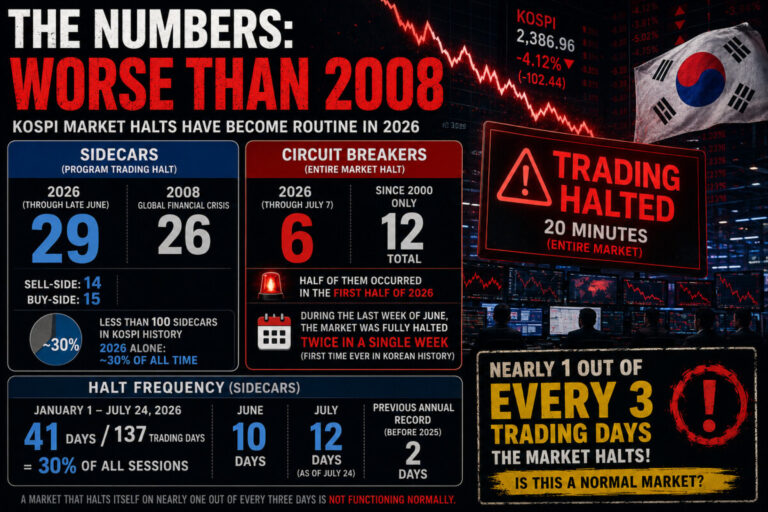
There’s only one way that math works: if the rate went up but the amount went down, the base it’s calculated on must have dropped, and dropped hard. Running the numbers, the fund’s NAV fell roughly 12–13% from June to July, reflecting the sharp early-July pullback in the KOSPI 200 and its biggest memory names. If anything, the higher rate may reflect the fund capturing richer option premiums during that spike in volatility — but the shrinking base still won out over the higher rate.
So the smaller check isn’t the fund turning stingy. Its rate went up. It’s the market base it pays from that got smaller for a month.
The Lesson
Here’s what I take from this, and what I’d want any reader to take too. Income from a covered call ETF breathes with the index underneath it. When the KOSPI 200 rises, your monthly check quietly grows. When it dips, the check dips with it — even if the fund’s payout rate holds steady or rises. A single lower month after 14 straight months of climbing isn’t a warning sign. It’s the mechanism doing exactly what it’s designed to do.
The paradox also teaches one more thing: don’t judge these funds by the headline distribution rate alone. A higher rate on a shrunken base can still hand you a smaller payout. Always watch the base, not just the percentage.
For me, 646,000 won lands this Monday — down a bit from last month, yes, but still part of the steady, breathing income stream that funds this chapter of my life. When the index recovers, the base recovers, and so does the check.
https://www.samsungfund.com/etf/product/view.do?id=2ETFP4
Final Thoughts
This month’s covered call ETF distribution fell about 7.7%, from 350 won to 323 won per share. The cause wasn’t a stingier fund — in fact, the rate rose — but a roughly 12–13% drop in the fund’s net asset value on the back of the early-July Korean market pullback. Zoom out, though, and this is still one of the great income climbs I’ve watched: up more than 165% from its low, with July marking its first real breather.
This is an informational look at my own holding, not financial advice, and I am not a licensed financial advisor. Distribution amounts and rates vary month to month and depend on market conditions; a fund’s net asset value can fall as well as rise, and covered-call strategies carry risks including capped upside and potential erosion of principal. All investing carries the risk of loss, including the loss of your entire principal. Please do your own research before investing.